
Laboratory Fluidized Bed Jet Mill
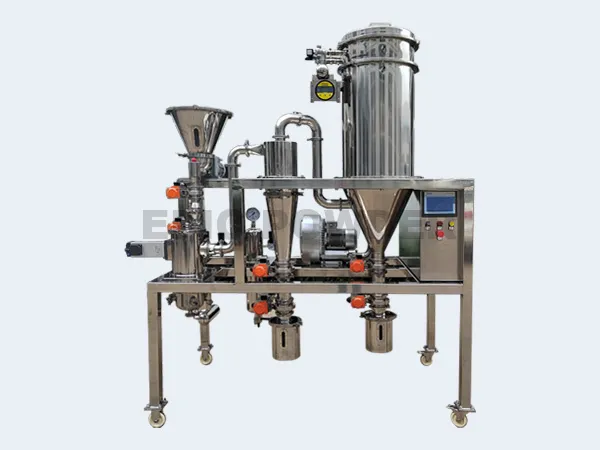
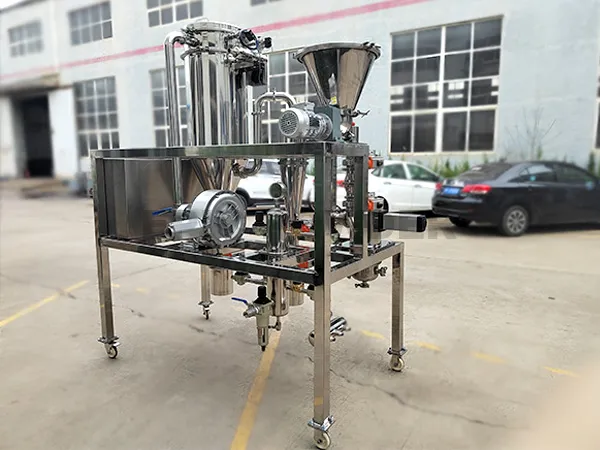
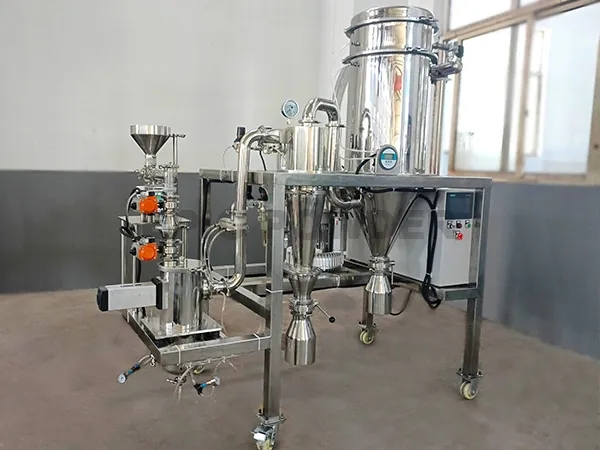
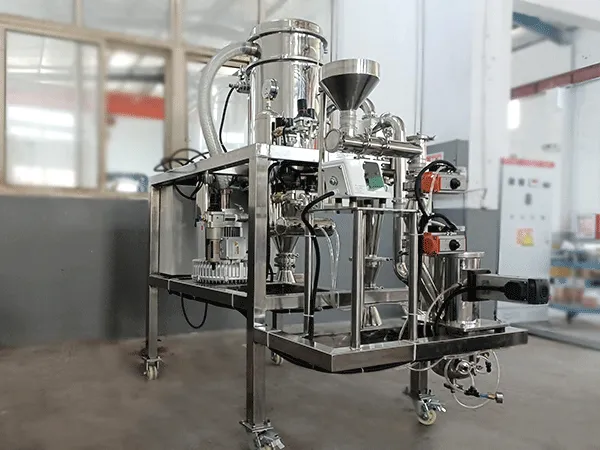
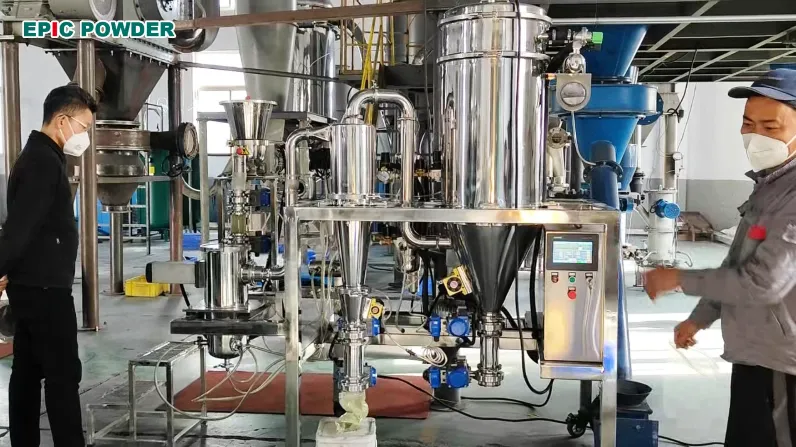
A Laboratory Fluidized Bed Jet Mill is a compact, highly precise air jet mill engineered for ultrafine size reduction of dry powders. Designed specifically for small-batch research and material development, this system utilizes high-velocity compressed gas or inert gas directed through opposed nozzles into a central grinding chamber.
Unlike conventional mills, particle size reduction occurs purely through high-energy, particle-to-particle collisions within a suspended, fluidized powder bed. Core architectural components include:
Fluidized Grinding Chamber: Suspends material in air, preventing wall impacts and delivering contamination-free grinding.
Integrated Dynamic Classifier: Positioned at the top of the chamber to continuously select particles that meet exact fineness criteria.
High-Precision Gas Jet Nozzles: Optimize kinetic energy transfer for rapid, predictable dry grinding.
How Does a Laboratory Fluidized Bed Jet Mill Work?
Our Laboratory Fluidized Bed Jet Mill relies on high-velocity gas energy rather than mechanical beaters to achieve precision powder processing. By suspending particles in an upward gas stream, we create an active grinding environment that delivers exact ultrafine size reduction without introducing unwanted wear or contamination.
The Fluidization and Grinding Mechanism
Inside the central grinding chamber, multi-directional nozzles direct high-pressure compressed gas inward and upward. This intense airflow expands rapidly, lifting and fluidizing the raw feed material into a suspended vortex.
Particle-on-Particle Collision: Powder particles collide with one another at sonic and supersonic velocities, causing rapid dry grinding.
Contamination-Free Grinding: Because grinding occurs exclusively through self-attrition (particle colliding with particle), material contact with the inner chamber walls is minimal.
Cooling Effect: The rapid expansion of compressed gas creates a natural cooling effect within the chamber, protecting heat-sensitive compounds from thermal degradation.
Integrated Dynamic Classifying Wheel
Positioned directly above the fluidized bed is an integrated dynamic classifying wheel that continuously monitors and controls particle size reduction.
Centrifugal Separation: As the gas carries pulverized material upward, the high-speed rotating wheel exerts centrifugal force on the particles.
Target Sizing: Particles that reach the desired fineness overcome the centrifugal barrier and pass through the wheel to the collection system.
Automatic Recirculation: Oversized particles are thrown back into the grinding zone for further impact, guaranteeing a exceptionally tight particle size distribution.

Closed-Loop System for Specialized Powders
For hazardous, reactive, or highly valuable materials, we engineer our laboratory air jet mill into a fully sealed closed loop system.
Inert Gas Operation: The system uses nitrogen or argon gas under pressure to prevent oxidation, combustion, or moisture exposure.
Continuous Gas Recirculation: Processed inert gas is filtered, recycled, and returned to the system, maximizing efficiency while maintaining high purity.
Complete Product Recovery: Sealed collection cyclones and high-efficiency filters ensure zero material loss and total safety during lab-scale runs.
Key Features and Advantages
We design our laboratory fluidized bed jet mills to deliver top-tier particle size reduction with absolute precision and repeatability. By focusing on smart engineering, we help R&D teams achieve consistent, high-yield results without compromising material purity.
Ultra-Fine Particle Size Control
Our air jet mill technology gives you complete control over particle size distribution. Using integrated dynamic classification, you can consistently achieve ultrafine size reduction down to sub-micron levels while eliminating unwanted oversized particles.
Steep Distribution Curve: Sharp top-cut control prevents over-grinding and excessive fines.
Narrow Micron Range: Easily adjust settings to target specific D50 or D90 parameters.
Consistent Dry Grinding: Delivers reliable, reproducible results across every test run.


Contamination-Free Grinding for High-Purity Materials
Purity is critical in advanced laboratory testing. Our system relies on fluidizing gas vectors that drive particle-to-particle collisions inside the central grinding chamber. Because particles crush against each other rather than hitting mechanical grinding tools, you get true contamination-free grinding.
Self-Grinding Principle: Eliminates media wear and foreign particle pickup.
Specialized Contact Liners: Available in alumina ceramic, silicon carbide, or polished stainless steel.
Inert Gas Ready: Safe processing for highly reactive, flammable, or heat-sensitive powders.
Low Wear and Minimal Material Loss
When working with costly lab samples and precious active ingredients, every gram counts. Our fluidized bed design drastically reduces equipment wear while maximizing product recovery rates.
FeatureDesign AdvantageImpact on Lab R&DNo Moving Grinding MediaEliminates heavy internal frictionReduces maintenance and spare part costsOptimized Chamber GeometryPrevents dead zones and wall adhesionEnsures maximum product yield per batchQuick-Release ClampsFast, tool-free disassemblySpeeds up cleaning and batch turnover

Technical Parameters of Jet Mill
| parameter/ Model | MQW03 | MQW06 | MQW10 | MQW20 | MQW30 | MQW40 | MQW60 | MQW80 | MQW120 | MQW160 |
|---|---|---|---|---|---|---|---|---|---|---|
| Feeding Size(mm) | <1 | <2 | <2 | <2 | <2 | <3 | <3 | <3 | <3 | <3 |
| Production Capacity(kg/h) | 0.3~10 | 10~150 | 20~300 | 40~600 | 100~900 | 200~1200 | 500~2000 | 800~3000 | 1500~6000 | 2000~8000 |
| Particle size(D97:μm) | 3~45 | 3~45 | 3~45 | 3~45 | 3~45 | 3~45 | 3~45 | 3~45 | 3~45 | 3~45 |
| Classifier motor (kw) | 2.2 | 3 | 5.5/7.5 | 7.5/11 | 11/15 | 15/7.5x3 | 7.5x3 | 11x3 | 15x3 | 15x4 |
| Air consumption(m³/min) | 3 | 6 | 10 | 20 | 30 | 40 | 60 | 80 | 120 | 160 |
| Air pressure(Mpa) | 0.6~1 | 0.6~1 | 0.6~1 | 0.6~1 | 0.6~1 | 0.6~1 | 0.6~1 | 0.6~1 | 0.6~1 | 0.6~1 |