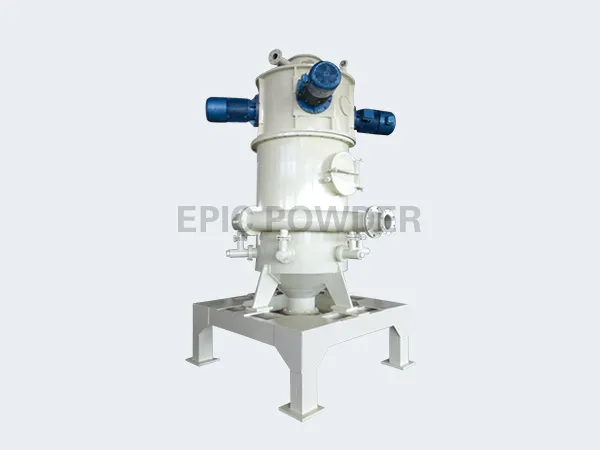
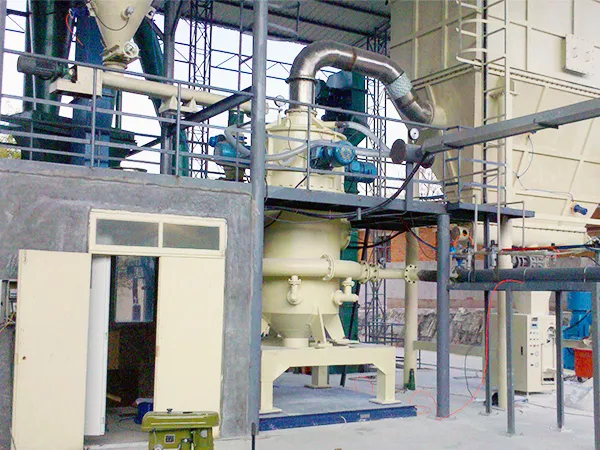
Horizontal Jet Mill for NdFeB Processing
Introduction to Horizontal Jet Mill for NdFeB Processing
Neodymium-Iron-Boron (NdFeB) permanent magnets require strict control over powder particle size, shape, and purity to achieve high magnetic performance. A Horizontal Jet Mill for NdFeB provides ultra-fine pulverization while protecting sensitive rare-earth alloys from oxidation and contamination. Designed for high-purity processing, these systems deliver the consistency required for high-grade sintered and bonded magnet manufacturing.
Working Principle of Horizontal Jet Milling
Horizontal jet milling relies on high-velocity fluid energy to achieve fluidization and particle-on-particle impact grinding without mechanical media wear.
Supersonic Acceleration: Compressed inert gas expands through specialized nozzles placed horizontally along the chamber wall, creating high-speed gas jets.
Autogenous Grinding: Raw NdFeB particles are carried into the jet stream, colliding primarily with each other to reduce size without contact with machine walls.
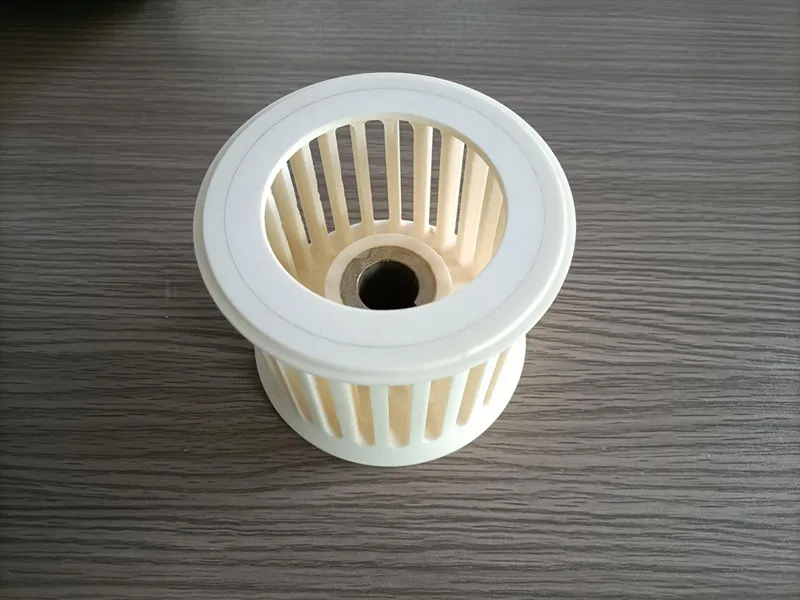
Dynamic Classification: Centrifugal forces generated by a high-precision classifier wheel separate fine particles from coarse materials, returning over-sized grains for re-grinding.


The Role of Milling in NdFeB Magnet Production
Precision milling directly determines the magnetic domain alignment and final performance of high-coercivity NdFeB magnets.
Production FactorImpact of Horizontal Jet MillingParticle Size ControlAchieves strict single-crystal particle targets (typically 3.0 to 5.0 µm).Particle DistributionDelivers a narrow particle size distribution, reducing magnetic domain defects.Sintering QualityOptimizes powder flowability and tap density for uniform press molding and sintering contraction.Oxidation ProtectionLimits surface area over-grinding, maintaining high remanence and coercivity.
Core Components of Horizontal Jet Pulverizer Systems
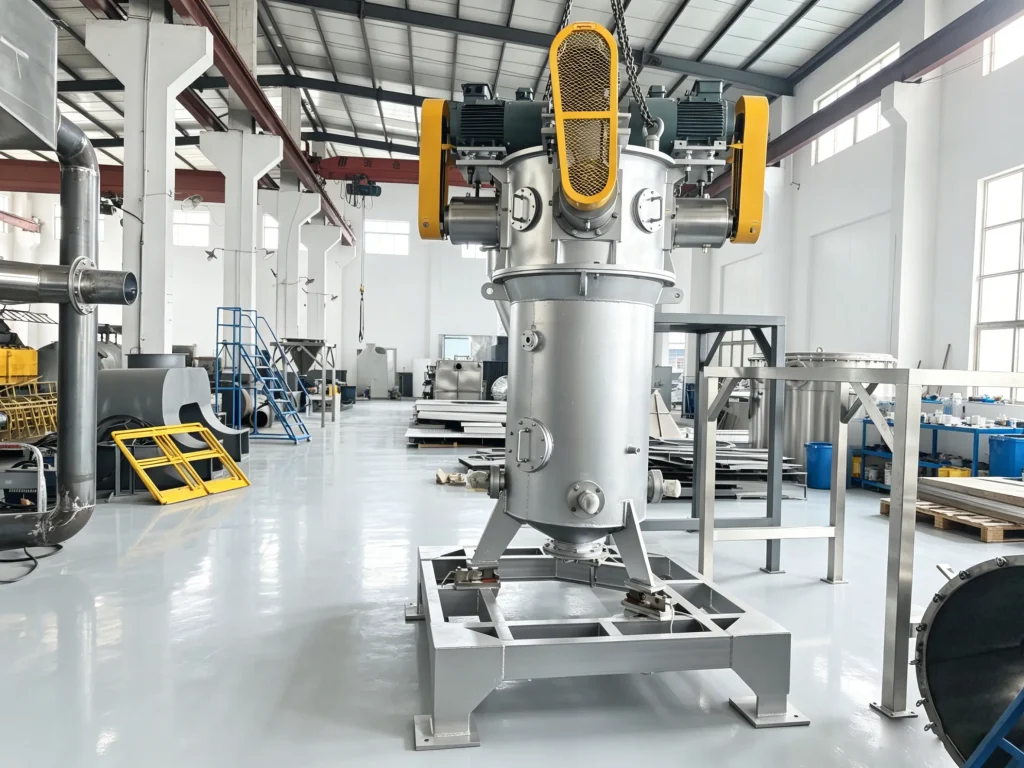
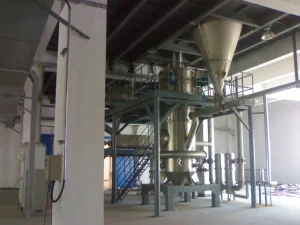
Horizontal Grinding Chamber: Built with wear-resistant liners (tungsten carbide or engineering ceramics) to ensure zero iron/metal cross-contamination.
Supersonic Nozzle Array: Configured to maximize kinetic energy transfer and reduce gas consumption.
Precision Air Classifier Wheel: Controls top-cut particle sizes dynamically via variable frequency drive adjustment.
Closed-Loop Inert Gas System: Recirculates nitrogen or argon with continuous gas cooling and oxygen monitoring.
Ultra-High Efficiency Cyclone Collector: Captures finished rare-earth powder while preventing ultrafine dust loss.
Technical Challenges in NdFeB Ultrafine Powder Milling
Milling Neodymium Iron Boron (NdFeB) rare earth alloys into ultrafine powders requires overcoming severe material stability and purity hurdles. Because rare earth materials are highly reactive, deploying a horizontal jet mill for NdFeB processing demands precise environmental and mechanical controls to ensure maximum magnetic performance.
Pyrophoricity and Oxidation Control
NdFeB alloy powders are inherently pyrophoric—they ignite spontaneously when exposed to air in ultrafine states. Controlling oxidation is critical, as oxygen content directly degrades the remanence ($B_r$) and coercivity ($H_{cj}$) of the final magnet.
High Reactivity: Ultrafine particles dramatically increase surface area, escalating ignition risks.
Oxygen Thresholds: Keeping oxygen levels strictly under 200 ppm during milling is essential to prevent magnetic performance loss.
Closed-Loop Protection: Our systems utilize high-purity nitrogen or argon gas loops to create a completely inert grinding atmosphere.
Contamination Control and Powder Purity
Cross-contamination or wear debris severely impacts magnetic alignment and domain wall movement in sintered NdFeB magnets.
Zero-Media Wear: Traditional mills introduce heavy media wear. Jet milling relies purely on particle-to-particle collisions.
Specialized Linings: Contact surfaces are lined with tungsten carbide, ceramics, or specialized polymers to eliminate metallic contamination.
Sealed Processing: Fully enclosed fluid systems prevent foreign dust or humidity from entering the powder stream.

Particle Size and Narrow Distribution Requirements
Achieving peak magnetic orientation during magnetic field pressing requires an exceptionally narrow particle size distribution (PSD), typically targeted between 3.0 and 5.0 microns.
Milling ChallengeImpact on NdFeB MagnetsEngineering SolutionOver-Grinding (< 1 µm)Causes rapid oxidation and severe powder lossHigh-precision air classifier cut-offsUnder-Grinding (> 8 µm)Creates multi-crystal grains, reducing coercivityOptimized jet nozzle placement and gas velocityBroad Particle SpreadPoor grain packing density and uneven sinteringIntegrated high-efficiency dynamic classifiers
By resolving these core challenges, our horizontal jet mill for NdFeB systems deliver uniform, high-purity powders optimized for high-grade permanent magnet production.
Technical Parameters of Jet Mill
| parameter/ Model | MQW03 | MQW06 | MQW10 | MQW20 | MQW30 | MQW40 | MQW60 | MQW80 | MQW120 | MQW160 |
|---|---|---|---|---|---|---|---|---|---|---|
| Feeding Size(mm) | <1 | <2 | <2 | <2 | <2 | <3 | <3 | <3 | <3 | <3 |
| Production Capacity(kg/h) | 0.3~10 | 10~150 | 20~300 | 40~600 | 100~900 | 200~1200 | 500~2000 | 800~3000 | 1500~6000 | 2000~8000 |
| Particle size(D97:μm) | 3~45 | 3~45 | 3~45 | 3~45 | 3~45 | 3~45 | 3~45 | 3~45 | 3~45 | 3~45 |
| Classifier motor (kw) | 2.2 | 3 | 5.5/7.5 | 7.5/11 | 11/15 | 15/7.5x3 | 7.5x3 | 11x3 | 15x3 | 15x4 |
| Air consumption(m³/min) | 3 | 6 | 10 | 20 | 30 | 40 | 60 | 80 | 120 | 160 |
| Air pressure(Mpa) | 0.6~1 | 0.6~1 | 0.6~1 | 0.6~1 | 0.6~1 | 0.6~1 | 0.6~1 | 0.6~1 | 0.6~1 | 0.6~1 |