
A jet mill buys its energy as compressed air, and that air is the reason the bill is high. The compressor takes 40–60% of the system’s startup cost and sets the power draw, so energy cost per ton answers to the air system and the grind target before it answers to the grinding chamber.
Where the Energy Goes
A jet mill grinds with compressed air or inert gas. It carries no rotating grinding media, so the mechanical load stays small. The compressor, by contrast, runs at full pressure whether the mill is loaded or empty.
Specific energy for a compressed air jet mill runs 35–60 kWh per ton at D50 ≈ 3 µm. Harder materials and finer targets push that figure to 300–800 kWh per ton. The room for savings sits between those two numbers.
Air consumption is the multiplier. A compressed-air jet mill processing CaCO₃ to D97 = 3–10 µm consumes about 800–1,500 m³ of air per ton of product.
At production scale the arithmetic compounds. A 10 t/h jet mill grinding CaCO₃ to D97 = 5 µm spends $960,000–$1,800,000 a year on electricity, depending on local rates.
Set the Grind Target to the Application
Energy rises steeply as the target size falls. A D97 = 20–45 µm cut runs on a simple configuration. D97 = 5 µm needs a high-performance classifier and precise airflow control. D97 = 3 µm or below adds classification stages and tighter tolerances.
Figure 1. Specific energy vs target particle size for jet milling versus ball milling
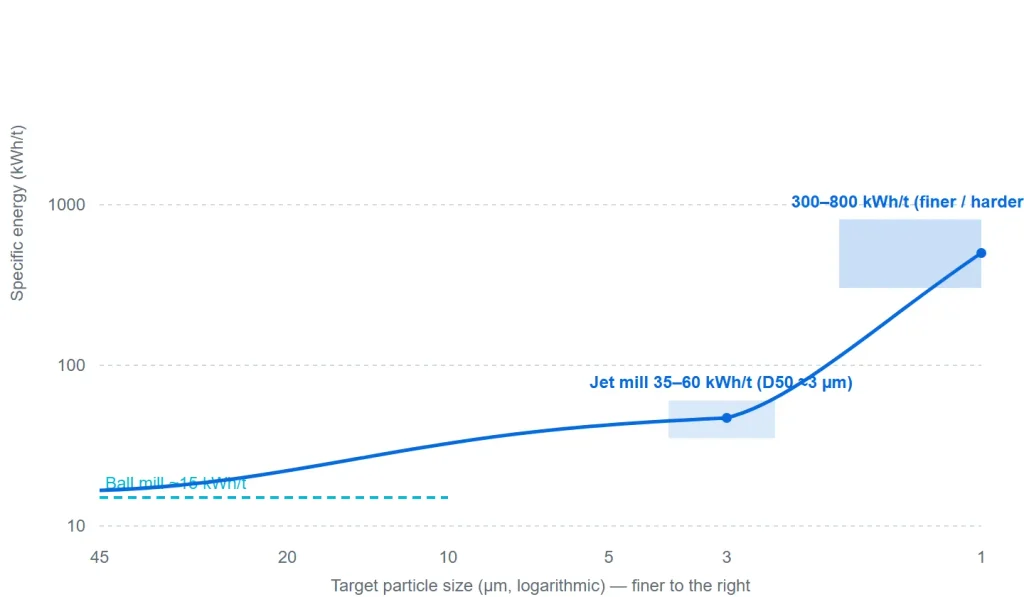
Logarithmic vertical axis. Bands mark the ranges Epic Powder published for D50 ≈ 3 µm (35–60 kWh/t) and for finer or harder feeds (300–800 kWh/t). The curve is a trend illustration; exact values depend on material and configuration.
Waste comes from grinding finer than the product needs. If a coating filler performs at D97 = 20 µm, chasing D97 = 5 µm multiplies energy per ton and changes nothing in the finished product.
A material test settles the question. Run the powder at two or three target sizes and check where the downstream application stops benefiting.
Feed Rate Sets the Cut
Feed rate controls residence time. At constant gas pressure, a faster feed raises mill loading, shortens residence time, and yields a coarser product. A slower feed makes particles finer.
Operators often hit a size target by slowing the feed, then absorb the energy cost. A gravimetric feeder holds the rate steady and lets the classifier control size.
Match Nozzle Pressure to the Material
Every material has a critical breakage pressure. Running just above it, typically 1.5–3× sonic pressure, gives enough particle acceleration without burning extra air. Quartz grinds well at 0.6–0.8 MPa; ductile plastics need more.
Laval nozzles convert pressure into a supersonic jet. Worn nozzles lose that conversion, and the compressor works harder for the same grind. Nozzle sets typically last 6–12 months, and a full replacement set for a mid-size mill costs $2,000–$8,000.
Keep the Classifier Cutting at Spec
In a fluidized bed jet mill, a classifying wheel separates fine from coarse. Coarse particles fall back to the grinding zone, and fine particles leave with the gas.
When wheel speed or airflow drifts, fine particles return to the grinding zone and get ground again. Setting the cut point to the product spec keeps that recirculation load low.
Dry the Feed
Wet feed sticks to the chamber wall and to itself, resists the jet, and needs more passes. A consistent feed moisture before milling removes that extra work.
Reuse the Gas
Jet milling runs cold because gas expansion cools the chamber, which suits heat-sensitive materials.
Closed-loop inert gas systems recirculate nitrogen and vent little of it. For oxygen-sensitive or flammable powders, this cuts gas consumption and cost.
Pick the Mill Type for the Duty
Spiral jet mills suit smaller batches and coarser cuts, and they cost less to build. Fluidized bed jet mills move more product per unit of air and hold a tighter particle size distribution, which suits fine cuts at production scale. A laboratory jet mill verifies a process before a production line is committed.
Sizing the Mill: The MQW Series
The MQW fluidized bed jet mill family spans ten models, from 0.3–10 kg/h on the MQW03 to 2,000–8,000 kg/h on the MQW160. Every model grinds to a D97 of 3–45 µm at 0.6–1.0 MPa air pressure.
MQW Fluidized Bed Jet Mill — Model Range
| Model | Capacity (kg/h) | D97 (µm) | Air (m³/min) |
| MQW03 | 0.3–10 | 2–45 | 3 |
| MQW06 | 10–150 | 2–45 | 6 |
| MQW10 | 20–300 | 2–45 | 10 |
| MQW20 | 40–600 | 2–45 | 20 |
| MQW30 | 100–900 | 2–45 | 30 |
| MQW40 | 200–1200 | 2–45 | 40 |
| MQW60 | 500–2000 | 2–45 | 60 |
| MQW80 | 800–3000 | 2–45 | 80 |
| MQW120 | 1500–6000 | 2–45 | 120 |
| MQW160 | 2000-8000 | 3–45 | 160 |
Feeding size <1–3 mm; air pressure 0.6–1.0 MPa; classifier motor from 2.2 kW (MQW03) to 15×4 kW (MQW160).
The table points to the sizing rule. Bigger mills cost more air per minute but far less air per ton, so a machine that runs near its rated capacity beats an oversized machine that idles.
Energy vs Total Ownership: Jet Mill or Ball Mill
Purchasing teams compare jet mills against ball mills, and the two part ways on energy. A ball mill runs about 15 kWh/t, a jet mill about 40 kWh/t, and a ball mill installs roughly 20 kW per tph against about 120 kW for a jet mill with its compressor.
Jet Mill vs Ball Mill — Operating Comparison
| Factor | Ball Mill | Jet Mill |
| Specific energy | ~15 kWh/t | ~40 kWh/t |
| Installed power per tph | ~20 kW | ~120 kW |
| Wear parts per ton | $2–$4 | $0.50–$1 |
| Operating cost per ton | $6–$12 | $18–$30 |
| Practical minimum size | D97 10–20 µm | D97 3–5 µm |
Figure 2. Jet mill vs ball mill: operating metrics compared
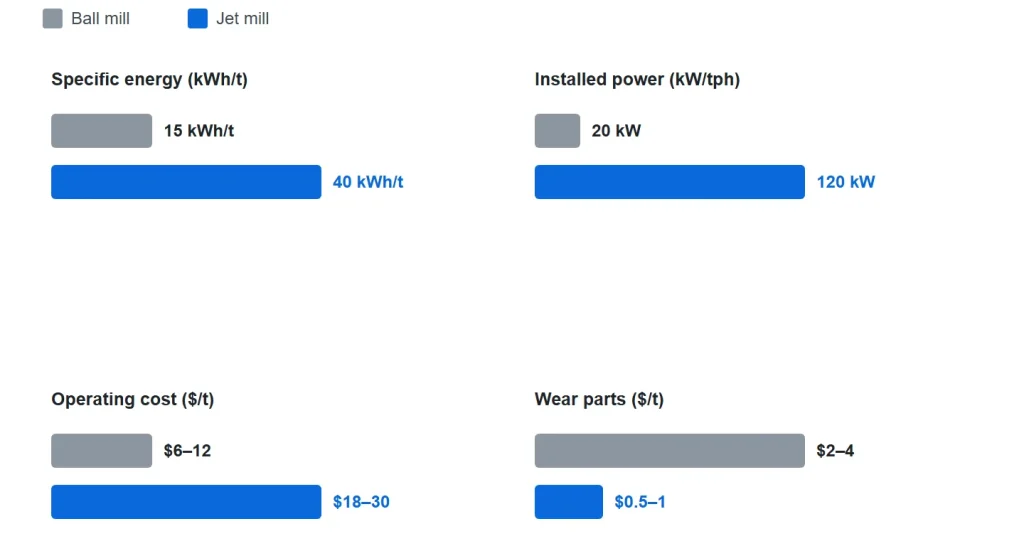
Bars show midpoint values from Epic Powder’s published ranges; labels give the full range. Specific energy, installed power, and operating cost run higher on a jet mill, while wear parts run lower.
The jet mill earns that premium where a ball mill cannot go. It reaches D97 = 3–5 µm against the ball mill’s practical 10–20 µm floor, holds metal pickup near zero, and slices wear parts to $0.50–$1 per ton against $2–$4.
Proof from Production Lines
A specialty carbon producer in Houston, Texas grinds needle coke to D50 = 2 µm for battery anodes. Its old line introduced metal contamination and caking. An MQW jet mill with a ceramic-lined chamber and closed-loop nitrogen supply delivered a stable D50 of 2 µm with no metal pickup.
A coating-industry project grinds ultrafine talc for paint filler on a fluidized bed jet mill. Read the talc grinding project for the line configuration.
A pharmaceutical job cuts calcium citrate on an MQP spiral jet mill, and an active-carbon project grinds coconut shell charcoal to an ultrafine cut. In each case, the air system and the classifier matched the target before the mill shipped.
Jet Mills by Epic Powder
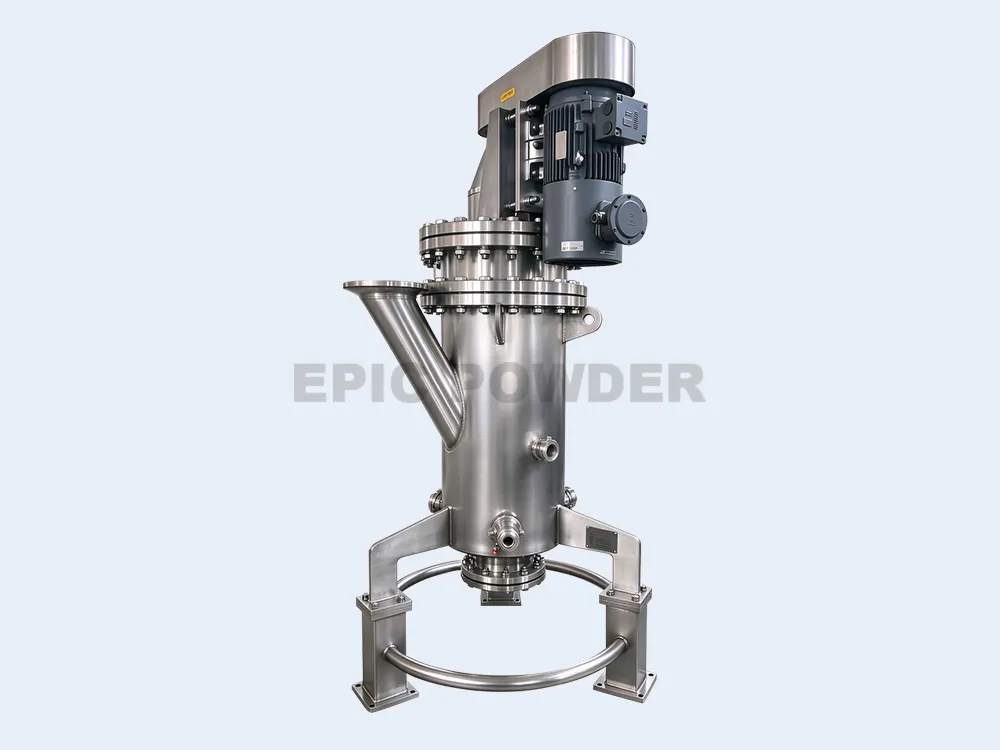
Epic Powder Machinery designs the MQW fluidized bed jet mills, MQP spiral jet mills, and MQL laboratory jet mills. The MQW uses Laval nozzles and a horizontal classifying wheel, with single or multiple wheels across the range.
Application builds cover lithium battery material, NdFeB magnets, non-metallic minerals, and inert-gas milling for flammable or oxidizable powders. Material-contact parts — inner walls, classifying wheels, and nozzles — take alumina, zirconia, or silicon carbide protection, and 316L stainless steel with a mirror-polished finish serves food and pharma grades.
Energy per Ton Is an Engineering Choice
Energy per ton on a jet mill follows from the air system and the grind target, both of which engineers set before the mill is ordered. A material test at two target sizes shows which combination meets the spec at the lowest specific energy.
Get a jet mill sized to your powder and your energy budget
Request a free material test or a quote, and our engineers will size the air system, classifier, and mill type to your target.
Epic Powder
Epic Powder designs grinding and classifying systems for minerals, chemicals, food, and pharmaceuticals. With more than 20 years of powder processing experience, we match the right mill to your target particle size and capacity. Tell us about your material and we will recommend a tested solution.

“Thanks for reading. I hope my article helps. Please leave a comment down below. You may also contact EPIC Powder online customer representative Zelda for any further inquiries.”
— Jason Wang, Engineer