
A jet mill and an air classifier mill look similar from the outside. Both feed powder into an air stream, carry an integrated classifier wheel, and discharge a single fine fraction. The two machines still split cleanly by fineness, wear and cost. The split comes down to one number: the target D97. Below about 5 µm, one machine answers, and above about 45 µm the other does. This article walks the jet mill vs air classifier mill decision band by band.
What Each Machine Does
A fluidised bed jet mill grinds without moving grinding parts. Nozzles accelerate compressed gas into the bed, and particles break each other in flight. An integrated turbine wheel holds the top cut, and most brittle materials finish between D97 2 and 45 µm. The grinding zone adds no metal of its own, because no steel rotor strikes the feed.
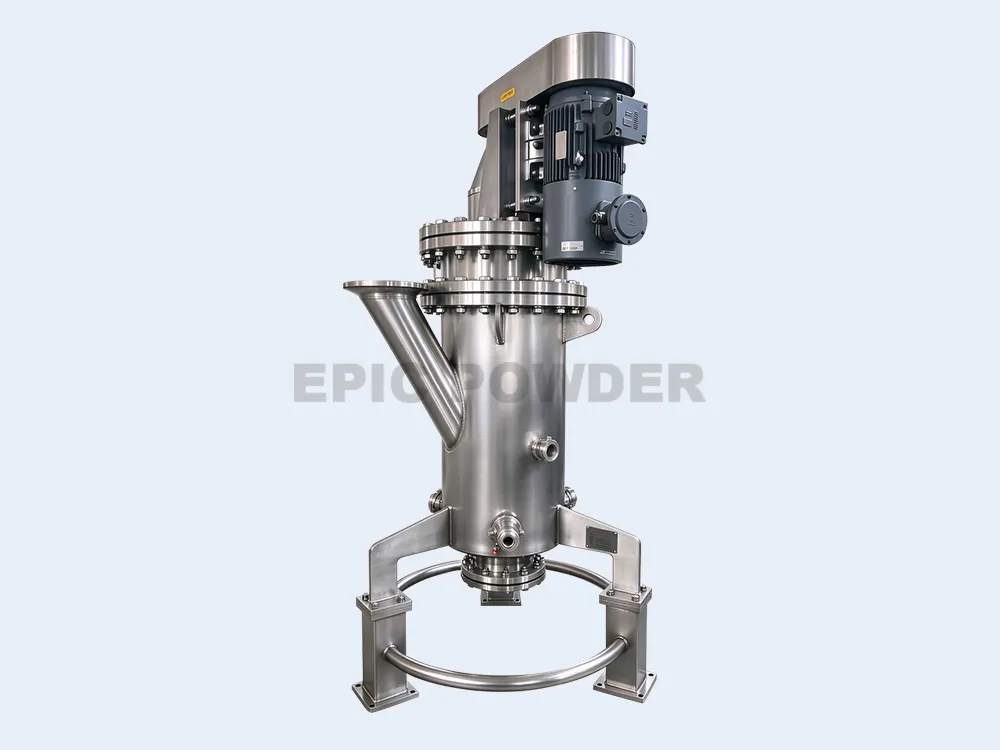
An air classifier mill, or ACM, grinds with a mechanical rotor. Hammers or pins strike the feed inside a shroud ring. A classifier wheel sorts the load in the same chamber. Typical output runs from D97 5 to about 300 µm, far above the jet mill band. The mechanical blow breaks particles faster than gas acceleration, so the machine turns over more tonnage at the coarse end.
| Feature | Jet mill | Air classifier mill |
|---|---|---|
| Grinding contact | Particle on particle, in gas | Steel rotor on particle |
| Practical D97 band | 2 to 45 µm | 5 to about 300 µm |
| Moving grinding parts | None in the grinding zone | Rotor, pins and liner |
| Gas source | Compressed air or inert gas | Ambient air through a fan |
| Energy driver | Gas compressor | Fan and rotor motor |
The Overlap Band Is Where the Decision Lives
Between D97 5 and 45 µm, both machines can hold the cut. The jet mill vs air classifier mill decision in that band sorts on three factors: abrasiveness, heat and purity.
Hard, sharp feeds come first, and fused silica, garnet and hard fillers chew through ACM pins and liners. Every worn gram of steel ends up in the product. The jet mill keeps the product clean where a rotor would smear it with metal. Its nozzles and liner still wear, and nozzle wear follows a schedule of its own. The grinding itself, though, never touches steel against the powder.
Soft or moderately hard feeds flip the picture. Calcium carbonate, graphite and dried plant materials grind well on an ACM. The machine holds those cuts at a fraction of the jet mill’s energy bill. Abrasiveness, more than fineness, settles the wear question.
Heat and Purity
Mechanical impact adds heat to the load, and a high-speed rotor runs warm at continuous duty. Coated battery materials, food actives and waxy compounds can smear or melt under that heat. Compressed gas expands as it enters a jet mill, so the grinding zone cools and soft materials finish cleaner there.
Purity follows the same logic, because an ACM sheds metal from pins, liners and classifier tips as they wear. A spec that limits iron or chromium may reject that shedding. A jet mill with ceramic-lined contact zones pushes metallic pickup down to trace levels. Battery cathode work and high-purity fillers land on this side of the line.
Energy and Throughput
A compressor feeds the jet mill, and compressor energy dominates the jet mill’s cost per ton. An ACM draws ambient air with a fan and adds rotor power, so its bill stays low at coarse cuts. Energy optimization on a jet mill line usually starts at the compressor, not at the mill itself.
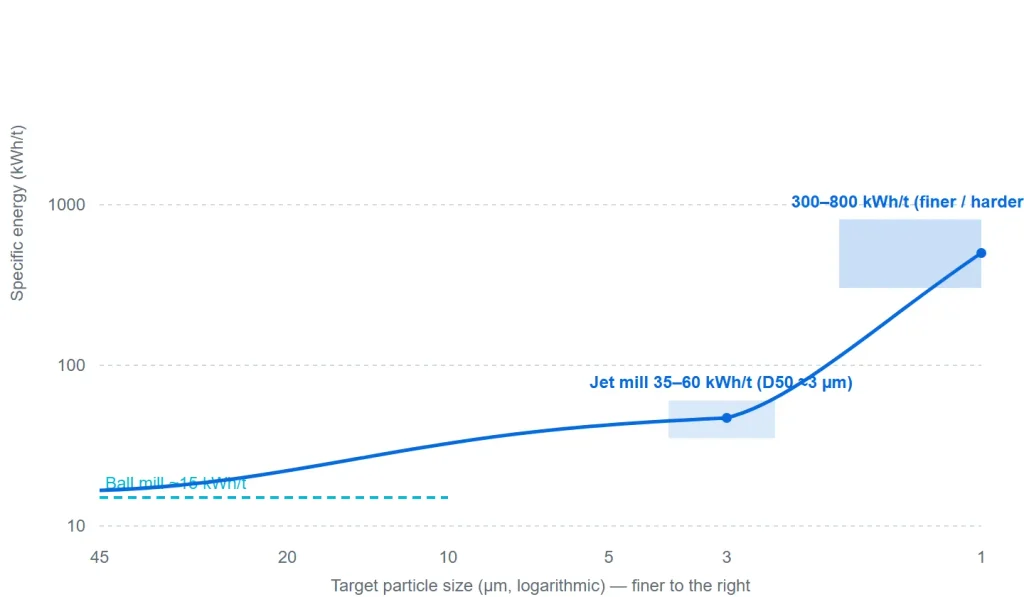
Throughput divides the same way. At a D97 near 45 µm, an ACM turns over several times the tonnage on the same power budget. Below D97 5 µm, the ratio reverses, because the ACM cannot hold that cut at all. The economic crossover falls inside the overlap band, and a trial on the real material finds it.
The Decision Table
| Condition | Better fit |
|---|---|
| D97 below about 5 µm | Jet mill |
| D97 between 45 and 300 µm | Air classifier mill |
| Abrasive feed, tight iron spec | Jet mill |
| Heat-sensitive or waxy feed | Jet mill |
| Coarse cut, high tonnage, tight budget | Air classifier mill |
| Inert grinding for flammable powder | Either, with an inert gas loop |
The comparison with ball mills follows a third logic again. The jet mill versus ball mill guide covers that split in depth.
Where a Trial Settles It
Paper analysis narrows the field, and the trial closes it. Run the same feed on both machines at the target cut. Record four items: PSD curve, yield, energy per ton, and metallic contamination in the product. Two runs on real material answer the overlap-band question in a day. They turn the table into numbers a purchase order can quote.
Buyers planning a first line should also read what a jet mill purchase involves, since installation costs differ between routes.
Which machine is cheaper to run?
The air classifier mill runs cheaper while the cut stays above roughly D97 10 µm. Its fan and rotor draw less power than the compressor behind a jet mill. As the target cut moves toward 5 µm, jet mill pressure climbs. The gap narrows until only the jet mill can hold the cut.
Can an air classifier mill reach D97 2 µm?
A standard ACM holds cuts down to about D97 5 µm. Below that, mechanical impact cannot deagglomerate and classify finely enough, and particle collisions in a jet mill take over. A trial confirms the exact floor for each material.
Does a jet mill need a compressor?
Yes. The grinding gas comes from a compressor sized to the mill, and plants without one should carry that cost in. Where the powder must not meet oxygen, the same loop runs on nitrogen and recirculates it.
Epic Powder
Epic Powder designs grinding and classifying systems for minerals, chemicals, food, and pharmaceuticals. With more than 20 years of powder processing experience, we match the right mill to your target particle size and capacity. Tell us about your material and we will recommend a tested solution.

“Thanks for reading. I hope my article helps. If you are unsure between a jet mill and an ACM, leave a comment with your target D97. You may also contact EPIC Powder online customer representative Molly for any further inquiries.”
— Mark Dai, engineer