Chemical Spiral Jet Mill
What is a Chemical Spiral Jet Mill?
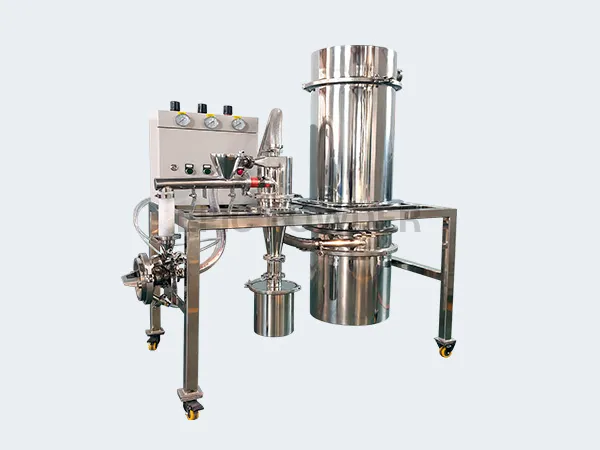
A Chemical Spiral Jet Mill is a high-precision fluid energy mill engineered for the ultra-fine micronization of dry solids without mechanical moving parts. High-pressure compressed air or inert gas enters a flat, pancake-shaped grinding chamber through tangential nozzles at supersonic speeds. This creates a high-speed spiral vortex where particle-to-particle collisions drive particle size reduction, yielding premium ultrafine powder down to low-micron or sub-micron ranges.
Role in Fine Chemical Powder Processing
In high-value fine chemicals manufacturing, exact physical properties and purity standards are mandatory. Chemical spiral jet mills serve as an essential processing tool by delivering:
Zero Contamination: Pure fluid-energy grinding eliminates metal wear debris common in traditional mechanical mills.
Thermal Protection: Rapid expansion of compressed air absorbs heat, keeping temperature-sensitive compounds stable.
Targeted Distribution: Produces extremely narrow particle size distributions for superior solubility, reactivity, and blend uniformity.
Difference Between Spiral and Fluidized Bed Jet Mills
Choosing between spiral and fluidized bed systems depends on space, maintenance, and processing goals:
FeatureChemical Spiral Jet MillFluidized Bed Jet MillClassifier TypeStatic centrifugal vortex (No moving components)Dynamic mechanical classifier wheelChamber GeometryHorizontal, low-profile pancake chamberVertical cylindrical vesselMaintenance & CleaningFast disassembly; ideal for quick chemical batch changesComplex disassembly and seal maintenanceSpace FootprintCompact design with minimal headroom requirementsTall vertical structure needing high ceiling clearanceBest ApplicationHigh-value fine chemicals, APIs, heat-sensitive materialsBulk minerals, abrasive ores, and heavy industrial feeds.
Working Principle of Chemical Spiral Jet Mills
Compressed Gas and High-Velocity Nozzle Injection
The process begins by feeding raw material into the system using a high-efficiency venturi nozzle. Dry compressed air or gas enters the perimeter of the grinding chamber through angled nozzles at supersonic speed.
Kinetic Conversion: Converts high grinding pressure directly into velocity.
Controlled Dosing: Maintains an even, continuous feed rate to prevent chamber clogging.
Spiral Vortex Generation and Particle Collisions
Inside the flat, cylindrical chamber, the high-speed gas jets create a powerful spiral vortex. Particles are swept into this high-velocity vortex, crashing into one another at high speeds.
Fluid Energy Milling: Driven entirely by particle-on-particle impact, avoiding internal mechanical wear.
Clean Processing: Delivers consistent micronization while keeping sensitive fine chemicals free from contamination.
Centrifugal Classification and Product Discharge
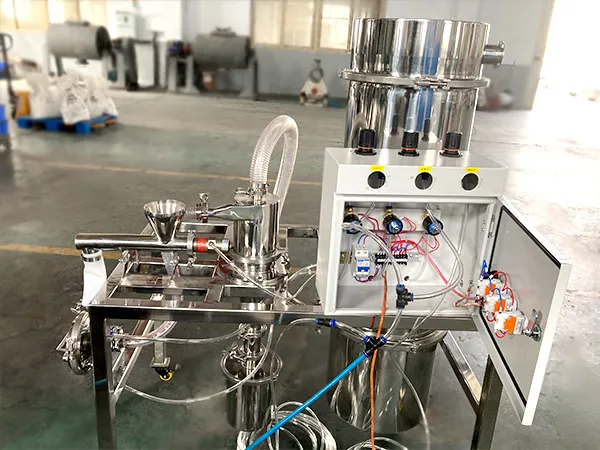
Classification occurs automatically inside our Chemical Spiral Jet Mill without moving parts, relying on two opposing forces:
ForceMechanismResultCentrifugal ForceDrives larger, heavy particles outward toward the chamber wallEnsures continuous particle size reduction until targets are metFluid Drag ForceCarries light, fully ground particles inward toward the central exitDischarges top-quality ultrafine powder cleanly into the collection system.
Key Features and Technical Advantages
We design our Chemical Spiral Jet Mill systems to deliver high-yield micronization with strict quality control. By using high-velocity compressed air instead of mechanical grinding media, our equipment ensures high purity, consistent output, and maximum operational efficiency.
FeatureTechnical BenefitTarget ApplicationCool Grinding ProcessGas expansion cooling prevents thermal degradationHeat-sensitive fine chemicals & polymersNo Moving PartsZero mechanical wear and minimal contaminationHigh-purity electronic & battery materialsNarrow PSD ControlPrecise particle classification in the grinding chamberUltrafine active chemical powdersTool-Free DisassemblyQuick washing and fast product changeoverMulti-product fine chemical processing
Ultra-Fine Particle Size Reduction
Our jet milling technology achieves consistent ultrafine powder production with extremely narrow particle size distributions.
Sub-Micron Precision: Reach top-cut sizes down to D97 < 2 µm effortlessly.
Precise Control: Adjust grinding pressure and material feed rate to hit exact target sizes.
Consistent Yield: Eliminates oversized grains without over-grinding fine particles.
No Heat Generation for Temperature-Sensitive Materials
Standard mechanical mills generate friction heat that melts or degrades delicate chemical compounds.
Gas Expansion Cooling: Expanding high-pressure air creates a natural cooling effect inside the unit.
Thermal Protection: Keeps chamber temperatures stable during continuous, high-speed runs.
Preserves Integrity: Ideal for low-melting-point waxes, heat-sensitive resins, and active chemical compounds.
Contamination-Free Micronization Design
Purity is critical when processing fine chemicals. We eliminate cross-contamination risks through smart engineering.
Media-Free Milling: Particles collide directly against each other, eliminating wear from traditional grinding media.
Advanced Liners: We offer ceramic, PTFE, and polyurethane linings inside the grinding chamber.
Cleanroom Ready: Fully enclosed systems prevent dust leaks and protect product purity.
Easy Maintenance and Rapid Cleaning
Downtime cuts directly into your production profit. We build our equipment for quick cleaning and effortless upkeep.
Fast Disassembly: Quick-release clamp connections allow tool-free teardown in minutes.
Smooth Surface Finish: Mirror-polished interior walls prevent powder buildup and simplify washing.
Simple Nozzle Access: Inspect or swap out the venturi nozzle setup without complex tools.
Technical Specifications and Operating Parameters
To achieve the exact particle size distribution from a Chemical Spiral Jet Mill, tuning your operational parameters is non-negotiable. We design our systems to give operators total control over key variables, ensuring predictable micronization and peak efficiency every run.
| parameter/ Model | MQP01 | MQP02 | MQP03 | MQP06 | MQP10 | MQP15 | MQP20 | MQP30 | MQP40 | MQP60 |
|---|---|---|---|---|---|---|---|---|---|---|
| Feeding Size(mm) | <1 | <2 | <2 | <2 | <2 | <3 | <3 | <3 | <3 | <3 |
| Particle size(D97:μm) | 8~150 | 8~150 | 8~150 | 8~150 | 8~150 | 8~150 | 8~150 | 8~150 | 8~150 | 8~150 |
| Production Capacity(kg/h) | 5-15 | 5~100 | 10~200 | 20~400 | 50~800 | 150~1500 | 300~2000 | 150~1500 | 300~2000 | |
| Air consumption(m³/min) | 1 | 2.5 | 3 | 6 | 10 | 15 | 20 | 30 | 40 | 60 |
| Air pressure(Mpa) | 0.7~0.85 | 0.7~0.85 | 0.7~0.85 | 0.7~0.85 | 0.7~0.85 | 0.7~0.85 | 0.7~0.85 | 0.7~0.85 | 0.7~0.85 | 0.7~0.85 |
| Installed power (kw) | 7.5 | 15~20 | 26~37 | 30~37 | 65~85 | 85~100 | 120~142 | 175~200 | 276~310 | 402~427 |
Related Cases
Get Your Jet Mill Price in 24 Hours:
Learn More About jet mills

Why Choose Jet Milling for LMFP Cathode Materials?
Why Does Spherical Silver Powder Agglomerate Before Sintering?