
A rare earth processor in Baotou, Inner Mongolia needed a production line for one job. Take rare earth compounds from a 325 mesh feed to a D97 below 3 µm, with no measurable contamination. Capacity had to reach 100 kg/h or more. Baotou sits at the center of global rare earth production. Its buyers in electronics, renewable energy and electric vehicles judge a powder on three numbers: size, distribution width and purity. The line we supplied met all three targets. This page explains why each target shaped the equipment choice the way it did.
Project Overview
| Item | Specification |
|---|---|
| Client | Rare earth processing company, Baotou, Inner Mongolia |
| Material | Rare earth compounds, including neodymium and cerium |
| Feed size | 325 mesh |
| Target particle size | D97 < 3 µm |
| Achieved particle size | D97 2.98 µm, narrow distribution |
| Target capacity | ≥ 100 kg/h |
| Achieved capacity | 120 kg/h, stable |
| Equipment | MQW fluidized bed jet mill with integrated high-precision classifier |
| Downstream use | Permanent magnets, catalysts, electronic materials |
What Makes Rare Earth Powders Hard to Grind
Purity is the product. Neodymium and cerium compounds sell at prices that make every gram of introduced contamination expensive. The penalty lands twice. It shows up in rejected batches. It shows up again in the magnetic or catalytic performance downstream, which depends on chemical integrity. Any grinding principle that wears media into the powder starts the project at a loss. That is why the client specified contamination-free processing as a hard requirement. Nothing less passed the acceptance test.
Many rare earth compounds are oxidation sensitive. Fine powders expose enormous new surface area to the air in an instant. Reactive surfaces degrade or pick up moisture before anyone has sampled them. A grinding process that also adds heat accelerates the same chemistry. Keeping the energy of grinding in the gas stream protects the compound. The gas carries the heat out of the chamber while the particles are at their most vulnerable.
Magnetic and catalytic performance tracks the distribution, and the coarse end of it. For magnet precursor powders, a single coarse particle becomes a defect site in the sintered magnet. For catalysts, reactivity follows the specific surface that a narrow, fine distribution maximizes. The specification was written as D97 because the top end matters. Holding D97 under 3 µm at tonnage is a classification problem as much as a grinding one.
The Line We Built
The core machine is a fluidized bed jet mill: particles break against each other, and nothing else touches them. High-speed compressed air accelerates the particles into the jet stream, where they collide mid-air and fracture. No rotor, no media and no hammer contacts the powder. The purity the client bought at the furnace is the purity that leaves the mill. The gas stream also removes the heat of grinding continuously. The product stays close to inlet temperature across a full shift.
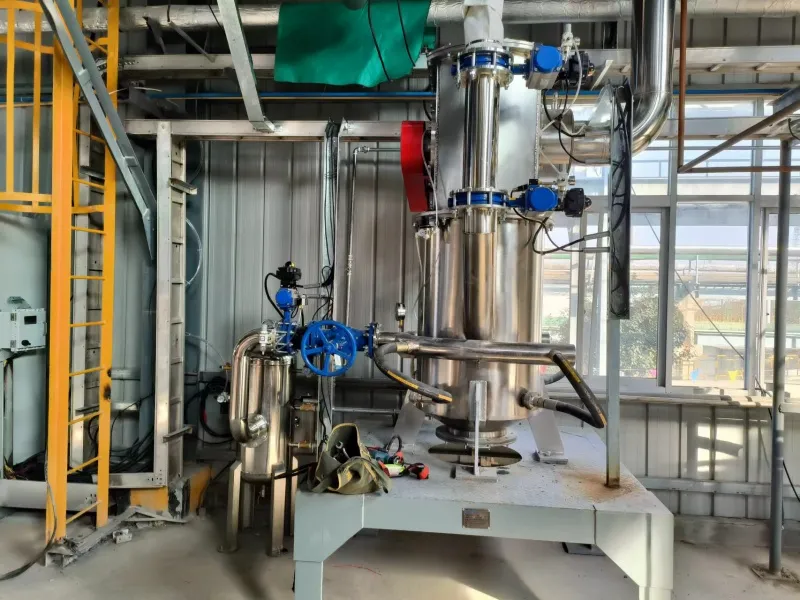
An integrated high-precision classifier sets the top size in real time. Particles below the cut leave with the gas; coarse ones fall back into the fluidized bed and re-enter the jets. That internal recirculation turns D97 from a lucky average into a controlled number. It held 2.98 µm across the acceptance run. Air pressure, feed rate and classifier speed are all adjustable. The commissioning team used that freedom to tune the balance between throughput and top size on the actual material.
The full equipment range behind this configuration is listed on the jet mill products page. The fluidized bed jet mill page covers the chamber sizes and gas consumption behind a 120 kg/h figure.
Results Against Target
| Metric | Target | Achieved |
|---|---|---|
| Feed size | 325 mesh | 325 mesh |
| Output D97 | < 3 µm | 2.98 µm |
| Production capacity | ≥ 100 kg/h | 120 kg/h |
| Contamination | None | None detected |
| Energy and maintenance | Below prior method | Reduced |
The client now feeds permanent magnet and catalyst production with a fully documented powder. Size, distribution and purity are recorded batch by batch. Capacity came in 20 percent above the original requirement. That left headroom for the demand growth rare earth markets have delivered consistently.
Where This Configuration Transfers
Polishing powders grind by the same logic. Cerium-based polishing powder needs a tight, fine distribution to polish optical glass uniformly. Media wear is as unwelcome there as it is here. Our polishing powder jet mill project in Malaysia ran the same fluidized bed principle on a different rare earth compound. Only the classifier cut differed.
Magnetic materials push the same requirements harder. NdFeB and other magnet alloys are both hard and oxidation sensitive. Our horizontal jet mill for NdFeB processing addresses that combination with a horizontal chamber layout. A producer grinding rare earth metals or alloys should read that page alongside this one.
Bring Us Five Numbers
- the material and its feed size
- the target D97, and any distribution limits at D10 or D50
- the hourly capacity you need
- your contamination limits, and whether the line must run inert
- the downstream application, since magnet, catalyst and phosphor powders classify differently
Send those five through the contact page. We will run the test on the same mill and classifier combination proposed for your line. The report you get back shows the distribution and the yield at your target. The numbers you plan around then come from a measurement on your own powder.