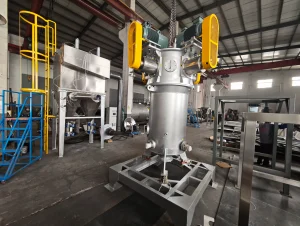
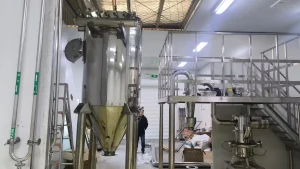
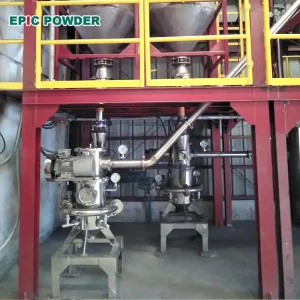
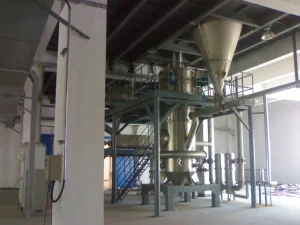

Pharmaceutical Spiral Jet Mill
What is a Pharmaceutical Spiral Jet Mill?
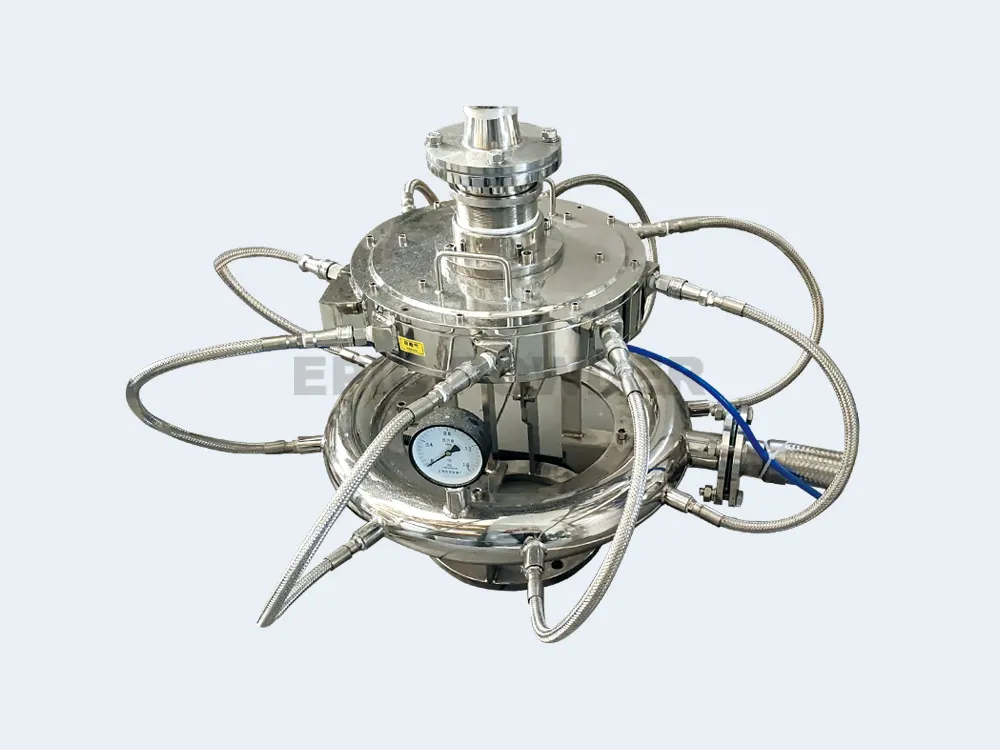
A pharmaceutical spiral jet mill—also known as a disc jet mill—is an advanced fluid energy impact mill engineered for precision size reduction. Designed specifically for high-purity processing, it converts active pharmaceutical ingredients (APIs) into ultrafine powder without mechanical heat generation or cross-contamination.
Overview of Spiral Jet Mill Technology
Spiral jet mill technology relies entirely on fluid energy rather than mechanical beaters or blades. High-pressure compressed air or inert nitrogen gas enters the flat, circular grinding chamber through tangential nozzles, generating a high-velocity spiral vortex.
Static Milling Zone: Eliminates moving parts inside the grinding area, preventing mechanical wear and heat generation.
Intense Particle Collision: High-speed gas jets drive particles to impact against one another, causing clean, natural self-grinding.
Contamination-Free Operation: Absence of grinding media ensures maximum purity for sensitive active ingredients.
Role of Jet Milling in Pharmaceutical Micronization
In modern drug formulation, micronization is critical for overcoming poor aqueous solubility and enhancing drug performance. Jet milling provides the tightest control over final particle size distribution, directly improving formulation consistency.
Performance CharacteristicImpact on API ProcessingControlled Particle SizeDelivers precise d90 particle cuts down to 1–5 microns.Increased Surface AreaMaximizes dissolution rates and accelerates bioavailability.Uniformity & StabilityEnsures batch-to-batch repeatability for inhaler powders, tablets, and suspensions.
Working Principle of Pharmaceutical Spiral Jet Mills
Understanding how a pharmaceutical spiral jet mill operates comes down to one core concept: pure fluid energy. Unlike traditional impact mills that rely on mechanical blades or hammers, our systems use high-velocity gas streams to achieve precise micronization without introducing wear contamination.
High-Velocity Fluid Energy Collision
We design our fluid energy systems to transform pressure into extreme particle velocity within the grinding zone:
High-Pressure Gas Jetting: Clean compressed air or inert nitrogen gas enters the flat, circular grinding chamber through specialized tangential nozzles.
High-Speed Spiral Vortex: The jet arrangement creates a powerful, high-velocity sonic vortex.
Particle Collision: As raw active pharmaceutical ingredients (APIs) enter the chamber, the swirling fluid forces intense particle-to-particle collision, causing the material to grind itself.
Because the process relies entirely on material colliding with material, heat generation is minimal, protecting sensitive active compounds.
Centrifugal Classification and Particle Size Control
Particle separation happens naturally inside the mill through two opposing forces acting within the spiral flow:
Force ActionOperating MechanismProcess OutcomeCentrifugal ForceDrives larger, heavier particles to the outer chamber perimeterHolds coarse material in the grinding zone for further size reductionCentripetal DragDraws lighter, ground particles toward the central exit portExports target ultrafine powder once it reaches size threshold
By adjusting gas grinding pressure and feed rates, we give operators direct control over the final particle size distribution, ensuring tight, reproducible results batch after batch.
Key Advantages in Pharmaceutical Processing
As a dedicated manufacturer of Pharmaceutical Spiral Jet Mills, we design our systems to overcome the toughest particle size reduction challenges in drug development and manufacturing.
Narrow Particle Size Distribution
Consistent Micronization: Delivers uniform ultrafine powder with an exceptionally tight particle size distribution curve.
No Oversized Particles: Dynamic fluid dynamics inside the grinding chamber ensure only particles meeting exact specifications exit the mill.
Superior Batch Quality: Eliminates batch-to-batch variation for predictable dissolution rates and formulation consistency.
Cold Grinding for Heat-Sensitive APIs
Natural Cooling Action: Expanding compressed air or nitrogen gas drops temperatures inside the mill, preventing thermal degradation.
API Integrity: Ideal for processing heat-sensitive active pharmaceutical ingredients without scorching or altering chemical structures.
Frictionless Design: Absence of mechanical moving parts prevents heat generation during continuous size reduction.

cGMP Compliance, Easy Cleaning, and Sterilization
Hygienic Construction: Built with mirror-polished 316L stainless steel to avoid material buildup and cross-contamination.
Rapid Turnaround: Tool-free clamp designs allow fast disassembly for thorough cleaning and inspection.
CIP/SIP Ready: Seamlessly integrates with Clean-in-Place and Sterilize-in-Place systems to maintain strict cGMP compliance.
Critical Parameters in Spiral Jet Milling
Fine-tuning a Pharmaceutical Spiral Jet Mill requires precise control over key operational variables. Achieving consistent micronization and a tight particle size distribution for active pharmaceutical ingredients (APIs) relies on optimizing three primary factors.
| parameter/ Model | MQP01 | MQP02 | MQP03 | MQP06 | MQP10 | MQP15 | MQP20 | MQP30 | MQP40 | MQP60 |
|---|---|---|---|---|---|---|---|---|---|---|
| Feeding Size(mm) | <1 | <2 | <2 | <2 | <2 | <3 | <3 | <3 | <3 | <3 |
| Particle size(D97:μm) | 8~150 | 8~150 | 8~150 | 8~150 | 8~150 | 8~150 | 8~150 | 8~150 | 8~150 | 8~150 |
| Production Capacity(kg/h) | 5-15 | 5~100 | 10~200 | 20~400 | 50~800 | 150~1500 | 300~2000 | 150~1500 | 300~2000 | |
| Air consumption(m³/min) | 1 | 2.5 | 3 | 6 | 10 | 15 | 20 | 30 | 40 | 60 |
| Air pressure(Mpa) | 0.7~0.85 | 0.7~0.85 | 0.7~0.85 | 0.7~0.85 | 0.7~0.85 | 0.7~0.85 | 0.7~0.85 | 0.7~0.85 | 0.7~0.85 | 0.7~0.85 |
| Installed power (kw) | 7.5 | 15~20 | 26~37 | 30~37 | 65~85 | 85~100 | 120~142 | 175~200 | 276~310 | 402~427 |