
A jet değirmeni spends most of its electricity making compressed air. The compressor takes 40–60% of the system’s startup cost and dominates the power draw, so energy cost per ton depends on the air system and the grind target more than on the grinding chamber.
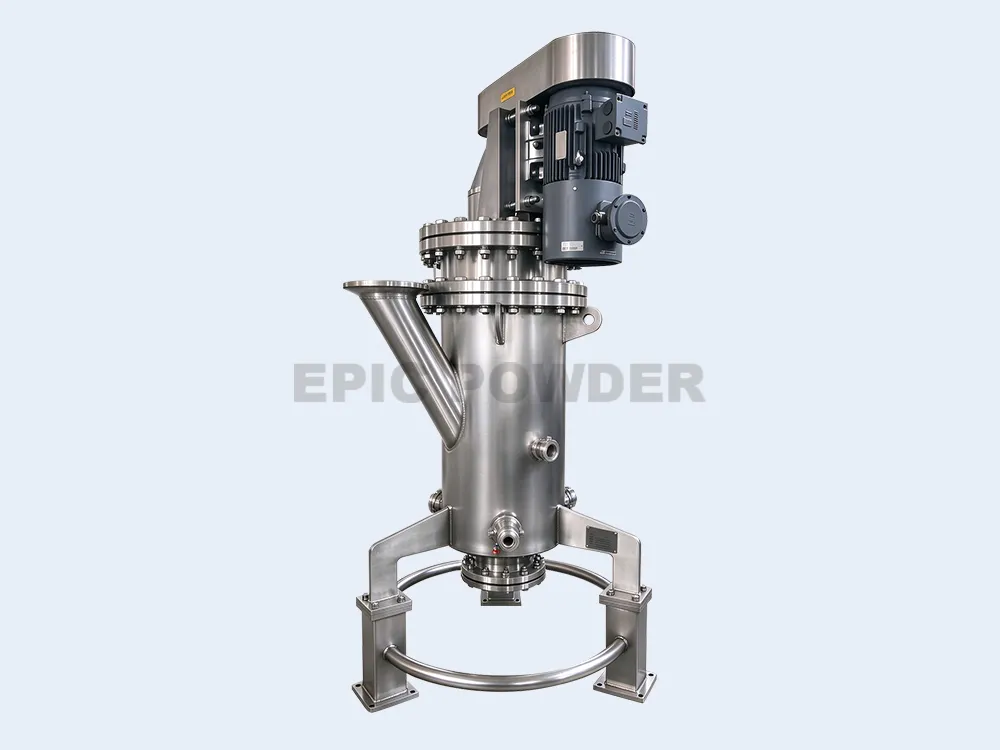
Where the Energy Goes
A jet mill grinds with compressed air or inert gas. It carries no rotating grinding media. The compressor does the work, and it holds full pressure whether the mill is loaded or running empty.
Specific energy consumption for a compressed air jet mill runs 35–60 kWh per ton at D50 ≈ 3 µm. Harder materials and finer targets push consumption to 300–800 kWh per ton. Most savings sit in the gap between those two ranges.
At production scale the numbers grow. A 10 t/h jet mill grinding CaCO₃ to D97 = 5 µm spends $960,000–$1,800,000 a year on electricity, depending on local rates.
Set the Grind Target to the Application
Energy rises sharply as the target particle size falls. A D97 = 20–45 µm cut runs on a simple configuration. D97 = 5 µm needs a high-performance classifier and precise airflow control. D97 = 3 µm or below adds classification stages and tighter tolerances.
Waste comes from grinding finer than the product needs. If a coating filler performs at D97 = 20 µm, chasing D97 = 5 µm multiplies energy per ton and changes nothing in the finished product. A material test settles the question. Run the powder at two or three target sizes and check where the downstream application stops benefiting.
Feed Rate Sets the Cut
Feed rate controls residence time. At constant gas pressure, a faster feed raises mill loading, shortens residence time, and yields a coarser product. A slower feed makes particles finer. Operators often reach a size target by slowing the feed, then absorb the energy cost. A gravimetric feeder holds the rate steady and lets the classifier control size.
Match Nozzle Pressure to the Material
Every material has a critical breakage pressure. Running just above it — typically 1.5–3× sonic pressure — gives enough particle acceleration without burning extra air. Quartz grinds well at 0.6–0.8 MPa; ductile plastics need more.
Laval nozzles convert pressure into a supersonic jet. Worn nozzles lose that conversion, and the compressor works harder for the same grind. Nozzle sets typically last 6–12 months, and a full replacement set for a mid-size mill costs $2,000–$8,000.
Keep the Classifier Cutting at Spec
In a fluidized bed jet mill, the classifying wheel separates fine from coarse. Coarse particles fall back to the grinding zone. Fine particles leave with the gas. When wheel speed or airflow drifts, fine particles return to the grinding zone and get ground again. Setting the cut point to the product spec keeps that recirculation load low.
Dry the Feed
Wet feed sticks to the chamber wall and to itself, resists the jet, and needs more passes. A consistent feed moisture before milling removes that extra work.
Reuse the Gas and the Heat
Jet milling runs cold. Gas expansion cools the chamber, which suits heat-sensitive materials. Closed-loop inert gas systems recirculate nitrogen and vent little of it. For oxygen-sensitive or flammable powders, this cuts gas consumption and cost.
Pick the Mill Type for the Duty
Spiral jet mills suit smaller batches and coarser cuts, and they cost less to build. Fluidized bed jet mills move more product per unit of air and hold a tighter particle size distribution, which suits fine cuts at production scale. Laboratory jet mills verify a process before a production line is committed.
Epik Toz
Epik Toz Machinery builds the MQW, MQL, and MQP fluidized bed jet mills, spiral jet mills, and laboratory jet mills. The MQW uses Laval nozzles and a horizontal classifying wheel, with single or multiple wheels across different capacities.
Application builds cover lithium battery material, NdFeB magnets, non-metallic minerals, and inert gas milling for flammable or oxidizable powders. Inner walls, classifying wheels, and nozzles take alumina, zirconia, or silicon carbide protection, so the grinding path stays clear of metal contact.
Epic Powder runs material tests in its own laboratory. A buyer can measure specific energy, throughput, and particle size on their own powder before choosing a configuration.
Energy per Ton Is an Engineering Choice
Energy per ton on a jet mill follows from the air system and the grind target, both of which engineers set before the mill is ordered. A material test at two target sizes shows which combination meets the spec at the lowest specific energy.

"Okuduğunuz için teşekkürler. Umarım makalem yardımcı olur. Lütfen aşağıya yorum bırakın. Ayrıca şunları da yapabilirsiniz: EPIC ile iletişime geçin Toz çevrimiçi müşteri temsilcisi Zelda Daha fazla bilgi için bize ulaşın.”
— Jason Wang, Mühendis