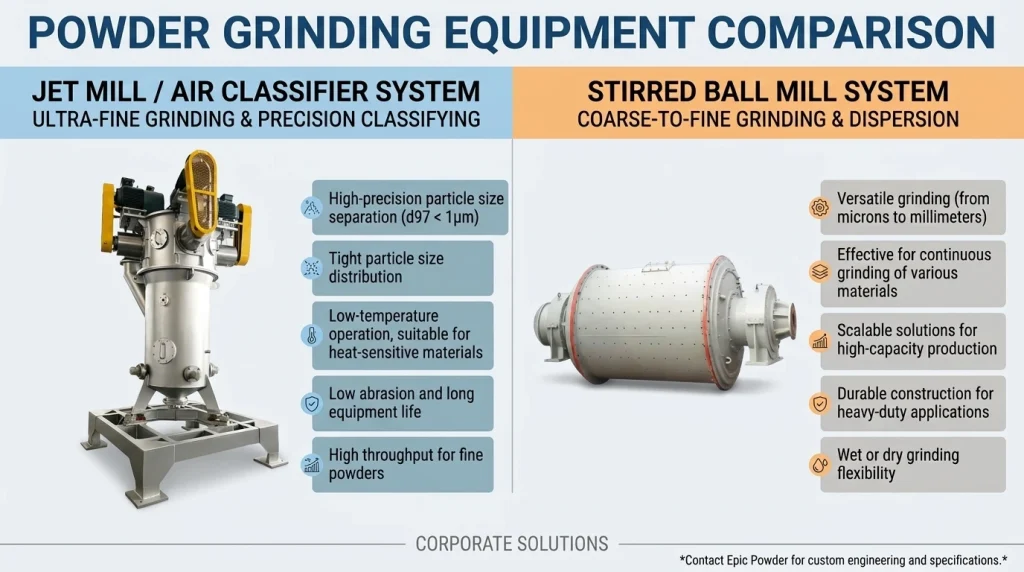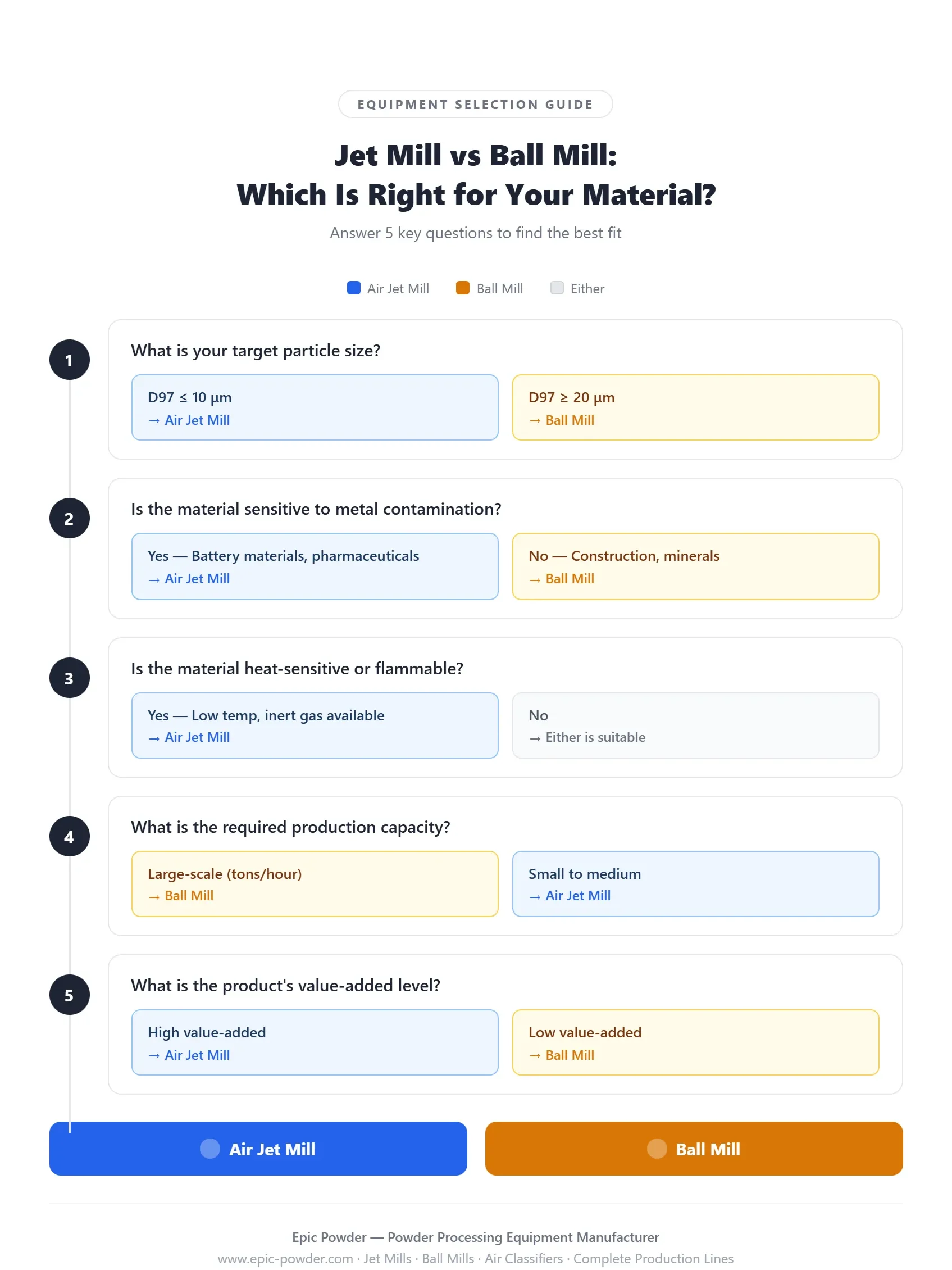
In the powder processing industry, jet mills and ball mills are the two most useful types of ultrafine grinding equipment. When selecting equipment, many customers ask the same question: “What exactly is the difference between a ジェットミル and a ball mill? Which one is better for my material?”
Simply put, air jet mills have higher production costs than ball mills and are suitable for grinding high-value-added materials. Jet mills grind materials using high-pressure gas; since the grinding process does not involve contact with metal grinding media, impurities are less likely to be introduced, making them more suitable for industries with strict purity requirements. However, this is only the most superficial difference—to make the right selection decision, you also need to understand their differences across multiple dimensions, including operating principles, particle size, energy consumption, and temperature rise. This article will provide a systematic comparison across seven core dimensions and offer clear recommendations for selecting the right equipment.

I. Working Principle
ジェットミルの動作原理
A jet mill utilizes high-pressure gas (compressed air, nitrogen, or superheated steam) accelerated to supersonic speeds through a special nozzle to create a high-speed gas flow field. Material particles are accelerated within the gas flow and collide, rub against each other, and undergo shear forces, thereby achieving pulverization. Throughout the process, the material collides only with the gas stream and with itself; it does not come into contact with any metal grinding media.
The jet mill incorporates a high-speed classifier wheel, allowing grinding and classification to occur simultaneously. Coarse particles are flung back for further grinding, while fine powder is discharged through the central outlet, enabling single-step powder production.
Ball Mill Working Principle
A ball mill operates by rotating the cylinder to lift the internal grinding media (steel balls, alumina balls, zirconia balls, etc.) to a certain height before releasing them, thereby impacting, grinding, and compressing the material. The material is pulverized through repeated impacts from the grinding media.
Ball mills typically require an external classifier to control the final particle size, as grinding and classification are two separate steps.
Key Difference: Air-jet mills rely on particle-on-particle grinding, where the material grinds against itself. Ball mills rely on media grinding, where the grinding media (balls) grind against the material. In the former, there is no contact with the grinding media, whereas in the latter, wear on the grinding media occurs.
II. Comparison of 7 Key Parameters
| Comparison Dimension | ジェットミル | Ball Mill |
|---|---|---|
| Source of Grinding Force | Supersonic air jet + particle-particle impact | Mechanical impact from grinding media (steel/ceramic balls) |
| Product Fineness (D97) | 2 – 45 μm, achievable down to submicron level | 5 – 74 μm (dry grinding); can reach finer with extended grinding time |
| 粒度分布 | Very narrow, tightly clustered | Relatively wide; classifier required for narrowing |
| Temperature Rise During Grinding | Below ambient (due to gas expansion cooling) | Significant rise; requires water or air cooling |
| Risk of Metal Contamination | Very low (no grinding media; ceramic liners optional) | Low to moderate (wear debris from grinding media) |
| エネルギー消費 | Relatively high (requires high-volume, high-pressure gas) | Relatively low (motor-driven shell rotation) |
| Throughput Capacity | 5 – 12,000 kg/h | 100 – 50,000 kg/h (significant advantage for large-scale production) |
III. Selection Guide
| Jet Mill – Recommended When: | Ball Mill – Recommended When: | |
|---|---|---|
| Fineness Requirement | Ultra-fine powder needed: target D97 ≤ 10 μm, e.g., battery cathode materials, pharmaceutical powders, advanced ceramics | Medium fineness acceptable: target D97 between 20 – 74 μm |
| Purity Requirement | High purity required: zero tolerance for iron/metal contamination, e.g., lithium-ion battery materials, electronic-grade powders, inhalation formulations | Minor contamination acceptable: industrial applications where purity is not extremely critical |
| 材料特性 | Heat-sensitive materials: low melting point or oxidation-prone substances, e.g., pesticides, pharmaceuticals, resin powders | Medium-hard materials: e.g., limestone, quartz, cement clinker, ores |
| Production Scale | Small to medium batches, high-value products | Large-scale production: high throughput requirements, e.g., building materials, mining, bulk chemicals |
| 粒子分布 | Narrow particle size distribution required: highly uniform particle size | Wider distribution tolerable |
| Cost Consideration | High product value justifies higher processing cost | Cost-sensitive projects: priority on controlling equipment investment and operating costs |
IV. Typical Industry Applications
| Industry / Material | Recommended Equipment | 理由 |
|---|---|---|
| Lithium-ion Battery Cathode Materials | ジェットミル | Zero iron contamination, ultra-fine particle size, narrow distribution |
| Pharmaceuticals / API (Active Pharmaceutical Ingredients) | ジェットミル | GMP compliance, low-temperature grinding, no media contamination |
| Advanced Ceramics / Electronic Powders | ジェットミル | High purity, submicron particle size |
| Pigments / Dyes | ジェットミル | Narrow particle size distribution, stable color consistency |
| Cement / Building Materials | Ball Mill | Large-scale production, cost-sensitive |
| Ore / Mineral Processing | Ball Mill | High throughput, moderate fineness |
| Quartz / Feldspar | Ball Mill + Classifier | Controllable cost, adjustable particle size |
V. Cost Comparison
A common mistake many customers make is comparing only the purchase price when selecting equipment. The real decision-maker is the total cost of ownership:
| Cost Item | ジェットミル | Ball Mill |
|---|---|---|
| Equipment Investment | Higher (includes air compressor system) | より低い |
| エネルギー消費 | Higher (high-pressure gas consumption) | Lower (motor power draw) |
| Grinding Media Replacement | None (media-free) | Periodic replacement of steel/ceramic balls |
| Liner Maintenance | Ceramic liners have long service life, infrequent replacement | Liners wear relatively fast, frequent maintenance |
| Product Loss / Yield | Low (high purity, minimal rejects) | Potential batch rejection due to contamination |
Selection Suggestion:
If your product has high added value and strict purity requirements, the higher equipment cost of a jet mill will be offset by lower product loss and higher quality premium. Conversely, if your product has low unit value and moderate purity requirements, the cost advantage of the ball mill becomes more prominent.
VI. Equipment Selection Checklist

Still not sure which one to choose? エピックパウダー offers professional material testing services, conducting grinding tests with your actual materials and using the data to help you make an informed decision. We manufacture both air jet mills (MQP Spiral Series / MQW Fluidized Bed Series) and ball mills, and we’ll provide the most suitable solution without bias.
結論
Both jet mills and ball mills have their strengths, neither is inherently better. The key is finding which one is more suitable for your specific application.
Choose a jet mill if you need ultra-fine grinding (D97 ≤ 10 μm), high purity, and low-temperature processing – even though it comes with higher energy consumption and upfront investment. It’s the go-to choice for high-value materials like battery cathodes, pharmaceuticals, and advanced ceramics. Choose a ball mill if your priority is large-scale production, low operating costs, and medium fineness (D97 20–74 μm). It’s a versatile workhorse for mining, building materials, and bulk chemicals.
The bottom line: start by defining your particle size target, purity requirements, throughput needs, and budget – then match those against the pros and cons of each technology. Not sure which one is right for you? The safest approach is to run a test grind with your actual material and let the results guide your decision. Data beats guesswork every time.
エピックパウダー
エピックパウダー, 超微粉末業界で20年以上の経験を有し、超微粉末の粉砕、研磨、分級、改質プロセスに重点を置き、超微粉末の将来的な発展を積極的に推進しています。. お問い合わせ for a free consultation and customized solutions!

読んでいただきありがとうございます。この記事が少しでもお役に立てれば幸いです。ぜひ下のコメント欄にご意見をお寄せください。 EPICにお問い合わせください パウダーオンラインカスタマー担当者 ゼルダ ご質問等ございましたら、お気軽にお問い合わせください。」
— ジェイソン・ワン, エンジニア