
Trong ngành công nghiệp chế biến bột, máy nghiền khí nén và máy nghiền bi là hai loại thiết bị nghiền siêu mịn hữu ích nhất. Khi lựa chọn thiết bị, nhiều khách hàng thường đặt cùng một câu hỏi: “Sự khác biệt giữa máy nghiền khí nén và máy nghiền bi là gì?” nhà máy phản lực Còn máy nghiền bi thì sao? Loại nào tốt hơn cho nguyên liệu của tôi?”
Nói một cách đơn giản, máy nghiền khí nén có chi phí sản xuất cao hơn máy nghiền bi và phù hợp để nghiền các vật liệu có giá trị gia tăng cao. Máy nghiền khí nén nghiền vật liệu bằng khí áp suất cao; vì quá trình nghiền không tiếp xúc với vật liệu nghiền kim loại, nên khả năng lẫn tạp chất ít hơn, do đó phù hợp hơn cho các ngành công nghiệp có yêu cầu độ tinh khiết nghiêm ngặt. Tuy nhiên, đây chỉ là sự khác biệt bề ngoài nhất – để đưa ra quyết định lựa chọn đúng đắn, bạn cũng cần hiểu sự khác biệt của chúng trên nhiều khía cạnh, bao gồm nguyên lý hoạt động, kích thước hạt, mức tiêu thụ năng lượng và sự tăng nhiệt độ. Bài viết này sẽ cung cấp một so sánh có hệ thống trên bảy khía cạnh cốt lõi và đưa ra các khuyến nghị rõ ràng để lựa chọn thiết bị phù hợp.
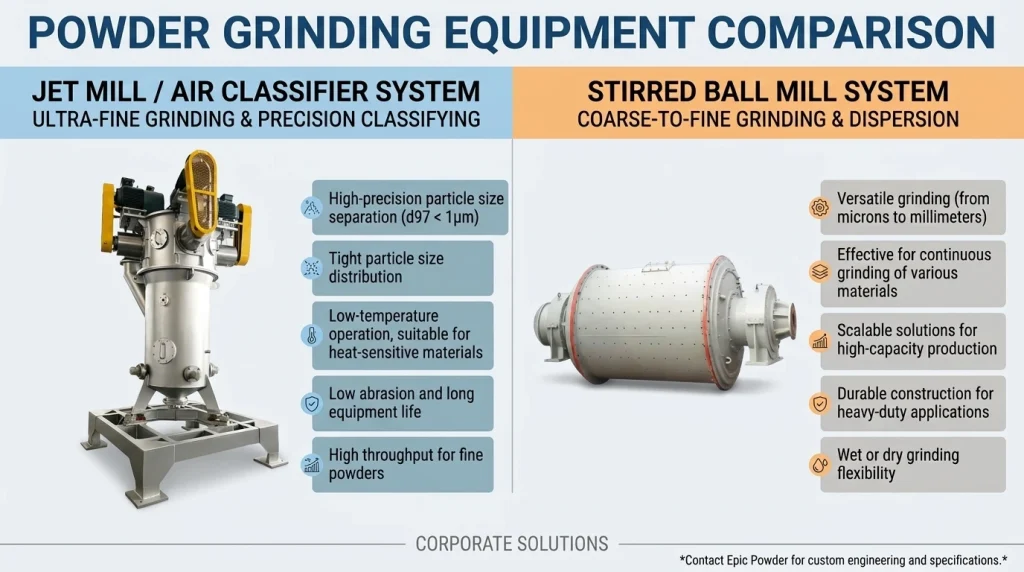
I. Nguyên lý hoạt động
Nguyên lý hoạt động của máy nghiền phản lực
Máy nghiền khí nén sử dụng khí áp suất cao (không khí nén, nitơ hoặc hơi nước siêu nóng) được gia tốc đến tốc độ siêu âm thông qua một vòi phun đặc biệt để tạo ra trường dòng khí tốc độ cao. Các hạt vật liệu được gia tốc trong dòng khí và va chạm, cọ xát vào nhau, chịu lực cắt, từ đó đạt được quá trình nghiền mịn. Trong suốt quá trình, vật liệu chỉ va chạm với dòng khí và với chính nó; nó không tiếp xúc với bất kỳ vật liệu mài kim loại nào.
Máy nghiền khí nén tích hợp bánh xe phân loại tốc độ cao, cho phép nghiền và phân loại diễn ra đồng thời. Các hạt thô được đẩy ngược trở lại để nghiền thêm, trong khi bột mịn được thải ra qua cửa thoát trung tâm, cho phép sản xuất bột chỉ trong một bước.
Nguyên lý hoạt động của máy nghiền bi
Máy nghiền bi hoạt động bằng cách quay xi lanh để nâng các vật liệu nghiền bên trong (bi thép, bi alumina, bi zirconia, v.v.) lên một độ cao nhất định trước khi thả chúng ra, từ đó tác động, nghiền và nén vật liệu. Vật liệu được nghiền nhỏ thông qua các va đập lặp đi lặp lại từ vật liệu nghiền.
Thông thường, máy nghiền bi cần một bộ phân loại bên ngoài để kiểm soát kích thước hạt cuối cùng, vì quá trình nghiền và phân loại là hai bước riêng biệt.
Điểm khác biệt chính: Máy nghiền khí nén dựa trên nguyên lý nghiền hạt-trên-hạt, trong đó vật liệu tự nghiền lẫn nhau. Máy nghiền bi dựa trên nguyên lý nghiền bằng vật liệu mài, trong đó vật liệu mài (bi) nghiền lẫn vào vật liệu. Ở loại máy thứ nhất, không có sự tiếp xúc giữa vật liệu mài và vật liệu, trong khi ở loại máy thứ hai, vật liệu mài bị mài mòn.
II. So sánh 7 thông số chính
| Kích thước so sánh | nhà máy phản lực | Máy nghiền bi |
|---|---|---|
| Nguồn gốc của lực mài | Luồng khí siêu thanh + va chạm giữa các hạt | Tác động cơ học từ vật liệu mài (bi thép/gốm) |
| Độ mịn của sản phẩm (D97) | 2 – 45 μm, có thể đạt được độ phân giải xuống đến mức dưới micromet. | 5 – 74 μm (nghiền khô); có thể đạt được kích thước nhỏ hơn nếu kéo dài thời gian nghiền. |
| Phân bố kích thước hạt | Rất hẹp, tập trung dày đặc | Phạm vi tương đối rộng; cần có bộ phân loại để thu hẹp phạm vi. |
| Tăng nhiệt độ trong quá trình mài | Dưới nhiệt độ môi trường xung quanh (do sự giãn nở của khí làm mát) | Tăng đáng kể; cần làm mát bằng nước hoặc không khí. |
| Nguy cơ nhiễm bẩn kim loại | Rất thấp (không có vật liệu mài; lớp lót gốm tùy chọn) | Mức độ thấp đến trung bình (mảnh vụn mài mòn từ vật liệu mài) |
| Tiêu thụ năng lượng | Tương đối cao (yêu cầu lượng khí lớn, áp suất cao) | Tốc độ quay tương đối thấp (quay vỏ bằng động cơ) |
| Dung lượng thông lượng | 5 – 12.000 kg/giờ | 100 – 50.000 kg/giờ (lợi thế đáng kể cho sản xuất quy mô lớn) |
III. Hướng dẫn lựa chọn
| Máy mài tia nước – Được khuyến nghị sử dụng khi: | Máy nghiền bi – Khuyến nghị sử dụng khi: | |
|---|---|---|
| Yêu cầu về độ mịn | Cần loại bột siêu mịn: kích thước mục tiêu D97 ≤ 10 μm, ví dụ như vật liệu catốt pin, bột dược phẩm, gốm sứ cao cấp. | Độ mịn trung bình chấp nhận được: mục tiêu D97 nằm trong khoảng 20 – 74 μm |
| Yêu cầu về độ tinh khiết | Yêu cầu độ tinh khiết cao: không chấp nhận bất kỳ tạp chất sắt/kim loại nào, ví dụ như vật liệu pin lithium-ion, bột dùng trong điện tử, các chế phẩm dùng cho đường hô hấp. | Mức độ nhiễm bẩn nhỏ có thể chấp nhận được: ứng dụng công nghiệp nơi độ tinh khiết không quá quan trọng. |
| Thuộc tính vật liệu | Vật liệu nhạy nhiệt: các chất có điểm nóng chảy thấp hoặc dễ bị oxy hóa, ví dụ như thuốc trừ sâu, dược phẩm, bột nhựa. | Vật liệu có độ cứng trung bình: ví dụ như đá vôi, thạch anh, clinker xi măng, quặng. |
| Quy mô sản xuất | Sản phẩm có giá trị cao, số lượng nhỏ đến trung bình | Sản xuất quy mô lớn: yêu cầu năng suất cao, ví dụ như vật liệu xây dựng, khai thác mỏ, hóa chất số lượng lớn. |
| Phân bố hạt | Yêu cầu phân bố kích thước hạt hẹp: kích thước hạt đồng nhất cao | Phân phối rộng rãi hơn có thể chấp nhận được |
| Xem xét chi phí | Giá trị sản phẩm cao justifies chi phí xử lý cao hơn | Các dự án nhạy cảm về chi phí: ưu tiên kiểm soát chi phí đầu tư thiết bị và chi phí vận hành. |
IV. Các ứng dụng điển hình trong ngành
| Ngành công nghiệp / Vật liệu | Thiết bị được đề xuất | Lý do |
|---|---|---|
| Vật liệu catốt pin lithium-ion | nhà máy phản lực | Không nhiễm bẩn sắt, kích thước hạt siêu mịn, phân bố hẹp. |
| Dược phẩm / API (Hoạt chất dược phẩm) | nhà máy phản lực | Tuân thủ GMP, nghiền ở nhiệt độ thấp, không gây ô nhiễm môi trường. |
| Gốm sứ tiên tiến / Bột điện tử | nhà máy phản lực | Độ tinh khiết cao, kích thước hạt dưới micromet |
| Chất màu / Thuốc nhuộm | nhà máy phản lực | Phân bố kích thước hạt hẹp, độ ổn định màu sắc cao. |
| Xi măng / Vật liệu xây dựng | Máy nghiền bi | Sản xuất quy mô lớn, nhạy cảm về chi phí |
| Chế biến quặng/khoáng sản | Máy nghiền bi | Năng suất cao, độ mịn vừa phải |
| Thạch anh / Feldspar | Máy nghiền bi + Máy phân loại | Chi phí có thể kiểm soát, kích thước hạt có thể điều chỉnh. |
V. So sánh chi phí
Một sai lầm phổ biến mà nhiều khách hàng mắc phải là chỉ so sánh giá mua khi lựa chọn thiết bị. Yếu tố quyết định thực sự là tổng chi phí sở hữu:
| Mục chi phí | nhà máy phản lực | Máy nghiền bi |
|---|---|---|
| Đầu tư thiết bị | Cao hơn (bao gồm hệ thống máy nén khí) | Thấp hơn |
| Tiêu thụ năng lượng | Mức tiêu thụ khí cao hơn (khí áp suất cao) | Thấp hơn (công suất tiêu thụ của động cơ) |
| Thay thế vật liệu mài | Không có (không kèm phương tiện truyền thông) | Thay thế định kỳ các viên bi thép/gốm. |
| Bảo trì lớp lót | Lớp lót gốm có tuổi thọ cao và ít cần thay thế. | Lớp lót bị mòn khá nhanh, cần bảo dưỡng thường xuyên. |
| Tổn thất sản phẩm / Hiệu suất | Thấp (độ tinh khiết cao, tỷ lệ tạp chất tối thiểu) | Lô hàng có nguy cơ bị loại bỏ do nhiễm bẩn. |
Gợi ý lựa chọn:
Nếu sản phẩm của bạn có giá trị gia tăng cao và yêu cầu độ tinh khiết nghiêm ngặt, chi phí thiết bị cao hơn của máy nghiền khí nén sẽ được bù đắp bằng tổn thất sản phẩm thấp hơn và giá thành cao hơn. Ngược lại, nếu sản phẩm của bạn có giá trị đơn vị thấp và yêu cầu độ tinh khiết vừa phải, lợi thế về chi phí của máy nghiền bi sẽ trở nên rõ rệt hơn.
VI. Danh sách kiểm tra lựa chọn thiết bị
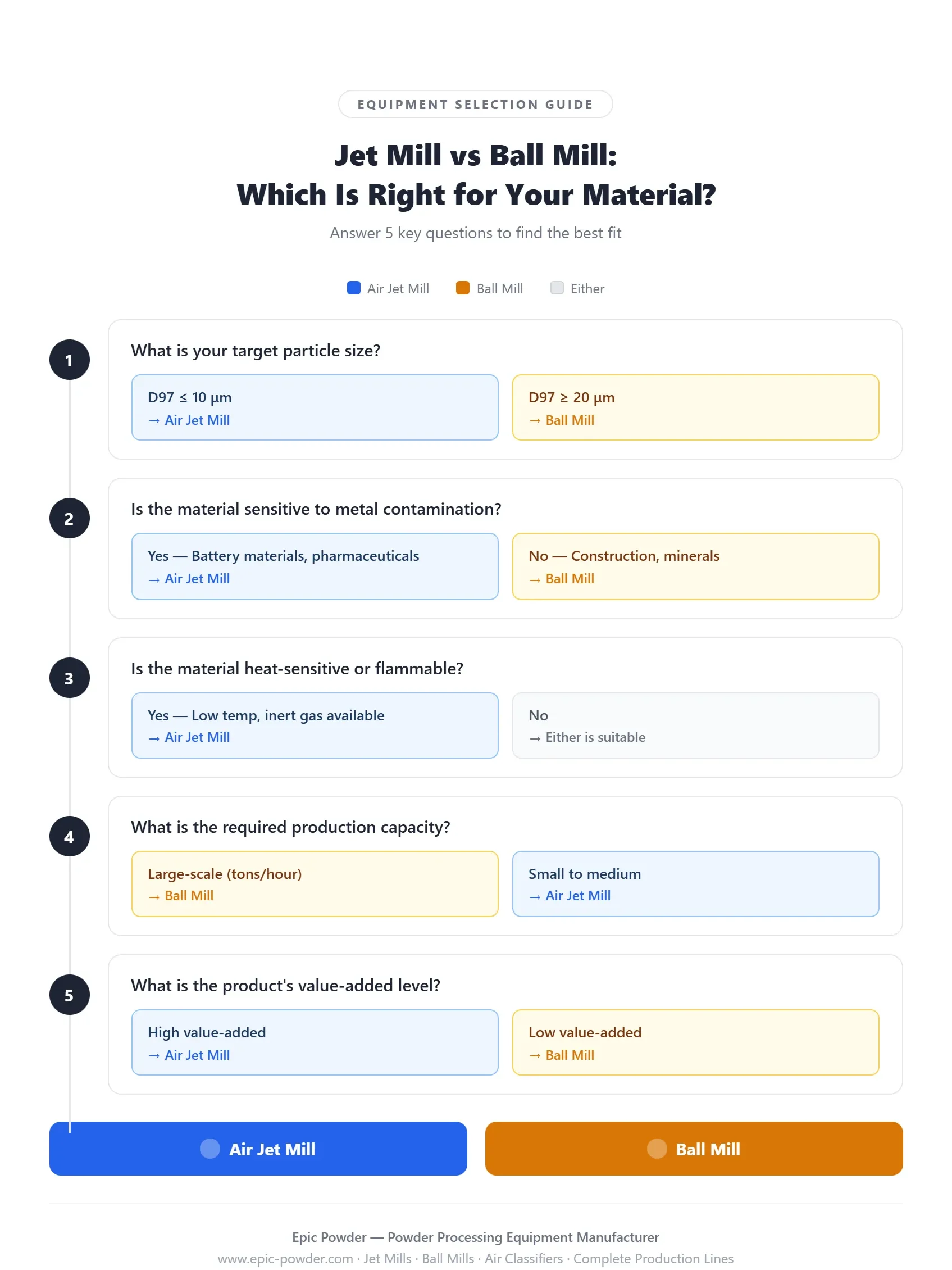
Vẫn chưa chắc nên chọn cái nào? Bột sử thi Chúng tôi cung cấp dịch vụ kiểm tra vật liệu chuyên nghiệp, tiến hành các thử nghiệm nghiền với vật liệu thực tế của bạn và sử dụng dữ liệu để giúp bạn đưa ra quyết định sáng suốt. Chúng tôi sản xuất cả máy nghiền khí nén (Dòng xoắn ốc MQP / Dòng tầng sôi MQW) và máy nghiền bi, và chúng tôi sẽ cung cấp giải pháp phù hợp nhất mà không thiên vị.
Liên hệ với chúng tôi để dùng thử miễn phí →
Phần kết luận
Cả máy nghiền khí nén và máy nghiền bi đều có những ưu điểm riêng, không có loại nào vượt trội hơn loại nào. Điều quan trọng là tìm ra loại nào phù hợp hơn với ứng dụng cụ thể của bạn.
Chọn máy nghiền khí nén nếu bạn cần nghiền siêu mịn (D97 ≤ 10 μm), độ tinh khiết cao và xử lý ở nhiệt độ thấp – mặc dù nó tiêu thụ nhiều năng lượng hơn và cần đầu tư ban đầu cao hơn. Đây là lựa chọn hàng đầu cho các vật liệu có giá trị cao như cực âm pin, dược phẩm và gốm sứ tiên tiến. Chọn máy nghiền bi nếu ưu tiên của bạn là sản xuất quy mô lớn, chi phí vận hành thấp và độ mịn trung bình (D97 20–74 μm). Nó là một thiết bị đa năng mạnh mẽ cho ngành khai thác mỏ, vật liệu xây dựng và hóa chất số lượng lớn.
Tóm lại: hãy bắt đầu bằng việc xác định kích thước hạt mục tiêu, yêu cầu độ tinh khiết, nhu cầu năng suất và ngân sách của bạn – sau đó so sánh những yếu tố đó với ưu điểm và nhược điểm của từng công nghệ. Không chắc chắn công nghệ nào phù hợp với bạn? Cách an toàn nhất là tiến hành thử nghiệm nghiền với nguyên liệu thực tế của bạn và để kết quả hướng dẫn quyết định của bạn. Dữ liệu luôn tốt hơn phỏng đoán.
Bột sử thi
Bột sử thi, Với hơn 20 năm kinh nghiệm trong ngành công nghiệp bột siêu mịn, tôi tích cực thúc đẩy sự phát triển của ngành bột siêu mịn, tập trung vào các quy trình nghiền, xay, phân loại và cải tiến bột siêu mịn. Liên hệ với chúng tôi Để được tư vấn miễn phí và giải pháp phù hợp với nhu cầu của bạn!

Cảm ơn bạn đã đọc. Tôi hy vọng bài viết của tôi có ích. Vui lòng để lại bình luận bên dưới. Bạn cũng có thể liên hệ EPIC Đại diện khách hàng trực tuyến của Powder Zelda cho bất kỳ yêu cầu thêm nào.”
— Jason Wang, Kỹ sư