
Dans l'industrie du traitement des poudres, les broyeurs à jet et les broyeurs à boulets sont les deux types d'équipements de broyage ultrafin les plus utilisés. Au moment de choisir un équipement, de nombreux clients se posent la même question : “ Quelle est exactement la différence entre un broyeur à jet et un broyeur à boulets ? » broyeur à jet et un broyeur à boulets ? Lequel est le mieux adapté à mon matériau ?”
En résumé, les broyeurs à jet d'air ont des coûts de production plus élevés que les broyeurs à boulets et conviennent au broyage de matériaux à haute valeur ajoutée. Ces broyeurs utilisent un gaz à haute pression pour broyer les matériaux ; comme le processus de broyage n'implique aucun contact avec des billes de broyage métalliques, le risque d'introduction d'impuretés est moindre, ce qui les rend plus adaptés aux industries aux exigences de pureté strictes. Cependant, il ne s'agit là que de la différence la plus superficielle. Pour faire le bon choix, il est également nécessaire de comprendre leurs différences sur de multiples plans, notamment les principes de fonctionnement, la granulométrie, la consommation d'énergie et l'élévation de température. Cet article propose une comparaison systématique sur sept critères essentiels et fournit des recommandations claires pour le choix de l'équipement le plus approprié.
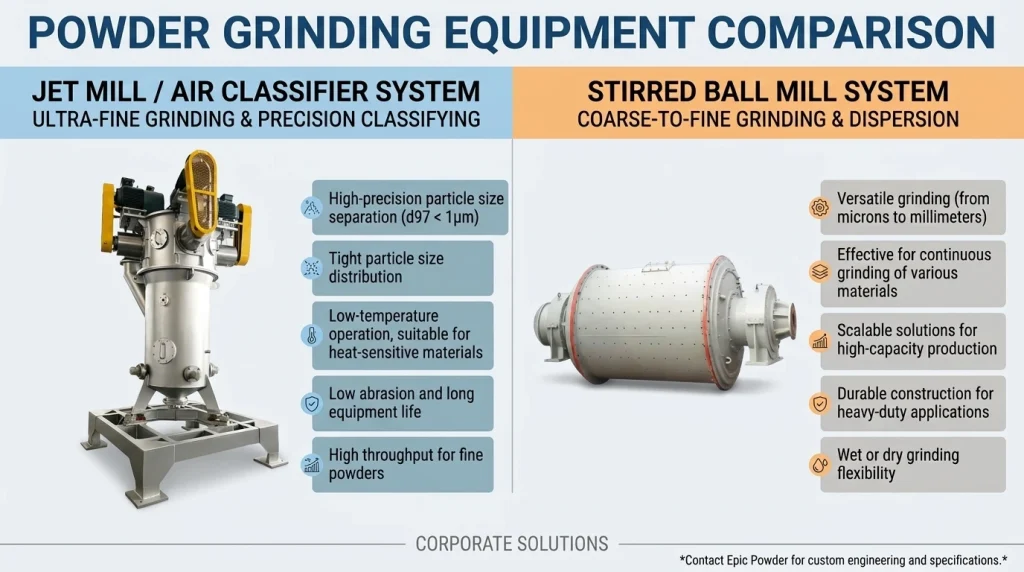
I. Principe de fonctionnement
Principe de fonctionnement du broyeur à jet
Un broyeur à jet utilise un gaz à haute pression (air comprimé, azote ou vapeur surchauffée) accéléré à des vitesses supersoniques par une tuyère spéciale afin de créer un champ d'écoulement gazeux à grande vitesse. Les particules de matériau sont accélérées dans ce flux et entrent en collision, se frottent les unes contre les autres et subissent des forces de cisaillement, ce qui permet leur pulvérisation. Durant tout le processus, le matériau n'entre en collision qu'avec le flux gazeux et avec lui-même ; il n'entre pas en contact avec des billes de broyage métalliques.
Le broyeur à jet intègre une roue de classification à grande vitesse, permettant le broyage et la classification simultanés. Les particules grossières sont renvoyées pour un broyage plus poussé, tandis que la poudre fine est évacuée par la sortie centrale, permettant une production de poudre en une seule étape.
Principe de fonctionnement d'un broyeur à boulets
Un broyeur à boulets fonctionne en faisant tourner le cylindre pour soulever les billes de broyage internes (billes d'acier, d'alumine, de zircone, etc.) à une certaine hauteur avant de les relâcher, ce qui provoque l'impact, le broyage et la compression du matériau. Le matériau est pulvérisé par les impacts répétés des billes de broyage.
Les broyeurs à boulets nécessitent généralement un classificateur externe pour contrôler la taille finale des particules, car le broyage et la classification sont deux étapes distinctes.
Différence principale : Les broyeurs à jet d’air fonctionnent par broyage particule contre particule, le matériau se broyant contre lui-même. Les broyeurs à billes fonctionnent par broyage média, les billes broyant le matériau. Dans le premier cas, il n’y a pas de contact direct avec le matériau, tandis que dans le second, l’usure du matériau est inévitable.
II. Comparaison de 7 paramètres clés
| Dimension de comparaison | Moulin à jet | Broyeur à boulets |
|---|---|---|
| Source de force de broyage | Jet d'air supersonique + impact particule-particule | Impact mécanique des billes de broyage (billes d'acier/céramique) |
| Finesse du produit (D97) | 2 à 45 μm, atteignable jusqu'au niveau submicronique | 5 à 74 μm (broyage à sec) ; une granulométrie plus fine peut être obtenue avec un temps de broyage prolongé. |
| Distribution granulométrique | Très étroit, très serré | Relativement large ; un classificateur est nécessaire pour affiner la recherche. |
| Élévation de température pendant le broyage | En dessous de la température ambiante (refroidissement dû à la détente des gaz) | Augmentation significative ; nécessite un refroidissement par eau ou par air |
| Risque de contamination par les métaux | Très faible (pas de média de broyage ; revêtements en céramique en option) | Faible à modérée (débris d'usure provenant des médias de broyage) |
| Consommation d'énergie | Relativement élevé (nécessite un volume important de gaz à haute pression) | Relativement faible (rotation de la coque entraînée par un moteur) |
| Capacité de débit | 5 – 12 000 kg/h | 100 – 50 000 kg/h (avantage significatif pour la production à grande échelle) |
III. Guide de sélection
| Jet Mill – Recommandé quand : | Broyeur à boulets – Recommandé quand : | |
|---|---|---|
| Exigence de finesse | Poudre ultrafine requise : cible D97 ≤ 10 μm, par exemple, matériaux de cathode de batterie, poudres pharmaceutiques, céramiques avancées | Finesse moyenne acceptable : D97 cible entre 20 et 74 μm |
| Exigence de pureté | Pureté élevée requise : tolérance zéro pour la contamination par le fer/métaux, par exemple, les matériaux des batteries lithium-ion, les poudres de qualité électronique, les formulations pour inhalation. | Une contamination mineure est acceptable : applications industrielles où la pureté n’est pas un critère extrêmement critique. |
| Propriétés matérielles | Matériaux thermosensibles : substances à bas point de fusion ou sujettes à l’oxydation, par exemple les pesticides, les produits pharmaceutiques, les poudres de résine. | Matériaux moyennement durs : par exemple, calcaire, quartz, clinker de ciment, minerais |
| Échelle de production | Petits et moyens lots, produits à haute valeur ajoutée | Production à grande échelle : exigences de débit élevées, par exemple, matériaux de construction, exploitation minière, produits chimiques en vrac |
| Distribution des particules | Distribution granulométrique étroite requise : taille des particules très uniforme | Une distribution plus large est tolérable |
| Considérations relatives aux coûts | La valeur élevée du produit justifie des coûts de traitement plus élevés | Projets sensibles aux coûts : priorité à la maîtrise des coûts d'investissement et d'exploitation des équipements |
IV. Applications industrielles typiques
| Industrie / Matériaux | Équipement recommandé | Raison |
|---|---|---|
| Matériaux de cathode pour batteries lithium-ion | Moulin à jet | Absence totale de contamination en fer, granulométrie ultra-fine, distribution étroite |
| Produits pharmaceutiques / API (Principes actifs pharmaceutiques) | Moulin à jet | Conformité aux BPF, broyage à basse température, absence de contamination du milieu |
| Céramiques avancées / Poudres électroniques | Moulin à jet | Haute pureté, taille des particules submicronique |
| Pigments / Colorants | Moulin à jet | Granulométrie étroite, couleur stable |
| Ciment / Matériaux de construction | Broyeur à boulets | Production à grande échelle, sensible aux coûts |
| Traitement des minerais | Broyeur à boulets | Débit élevé, finesse modérée |
| Quartz / Feldspath | Broyeur à boulets + classificateur | Coût maîtrisable, taille des particules ajustable |
V. Comparaison des coûts
Une erreur fréquente chez de nombreux clients est de ne comparer que le prix d'achat lors du choix d'un équipement. Le véritable facteur de décision est le coût total de possession.
| Article de coût | Moulin à jet | Broyeur à boulets |
|---|---|---|
| Investissement en équipement | Supérieur (système de compresseur d'air inclus) | Inférieur |
| Consommation d'énergie | Consommation de gaz à haute pression plus élevée | Diminuer (consommation électrique du moteur) |
| Remplacement des médias de broyage | Aucun (sans médias) | Remplacement périodique des billes en acier/céramique |
| Entretien des revêtements | Les revêtements en céramique ont une longue durée de vie et nécessitent un remplacement peu fréquent. | Les doublures s'usent relativement vite, entretien fréquent. |
| Perte de produit / Rendement | Faible (pureté élevée, rejets minimaux) | Rejet potentiel du lot en raison d'une contamination |
Suggestion de sélection :
Si votre produit présente une forte valeur ajoutée et des exigences de pureté strictes, le coût plus élevé d'un broyeur à jet sera compensé par des pertes de produit réduites et une qualité supérieure. En revanche, si votre produit a une faible valeur unitaire et des exigences de pureté modérées, l'avantage économique du broyeur à boulets sera plus marqué.
VI. Liste de vérification pour la sélection de l'équipement
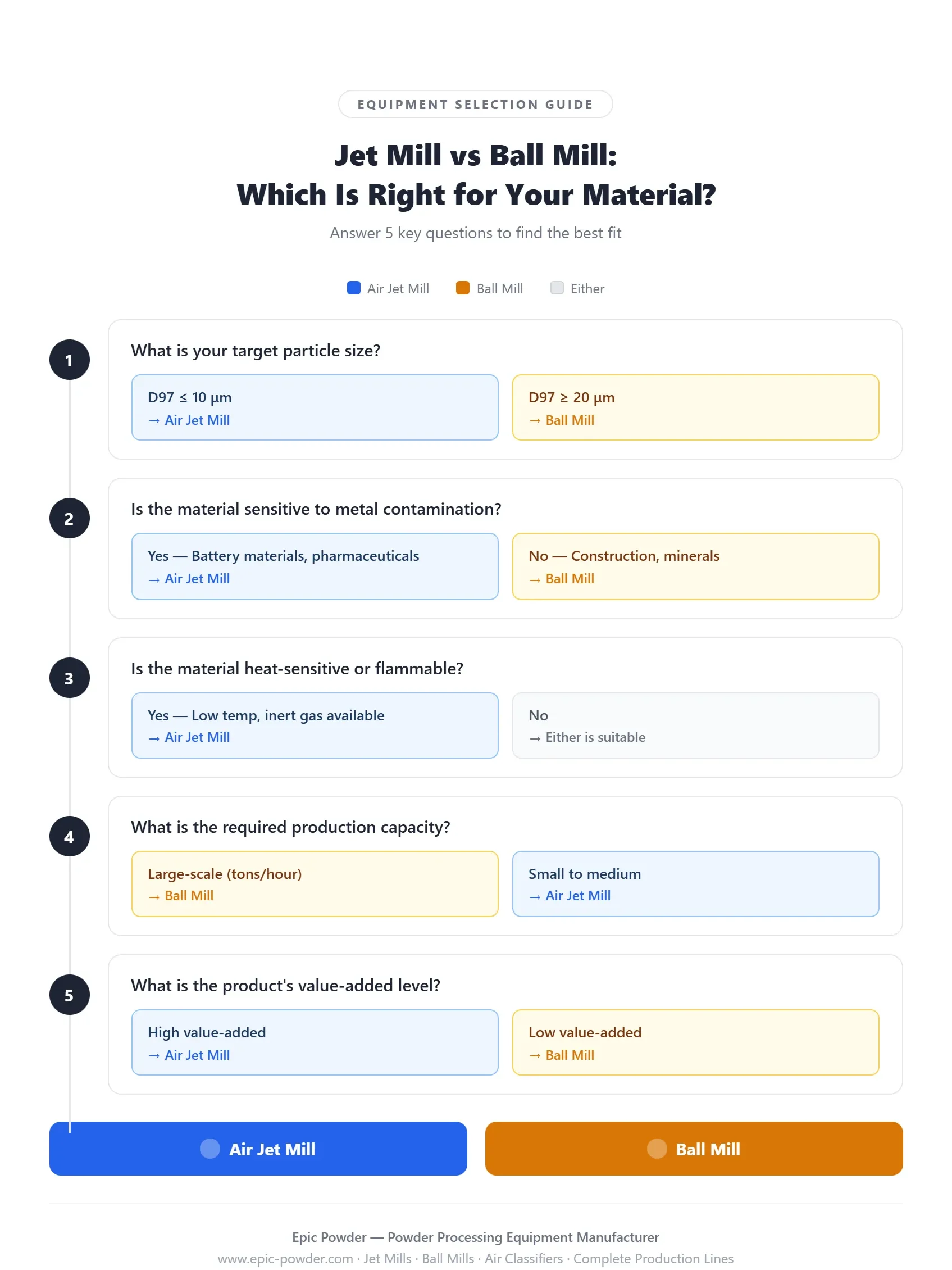
Vous hésitez encore sur le choix à faire ? Poudre épique Nous proposons des services professionnels d'essais de matériaux, en réalisant des essais de broyage sur vos matériaux et en utilisant les données obtenues pour vous aider à prendre une décision éclairée. Nous fabriquons des broyeurs à jet d'air (séries MQP Spiral et MQW à lit fluidisé) et des broyeurs à boulets, et nous vous fournirons la solution la plus adaptée à vos besoins, en toute impartialité.
Contactez-nous pour un essai gratuit →
Conclusion
Les broyeurs à jet et les broyeurs à boulets présentent chacun leurs avantages, sans qu'aucun ne soit intrinsèquement meilleur. L'essentiel est de trouver celui qui convient le mieux à votre application spécifique.
Optez pour un broyeur à jet si vous avez besoin d'un broyage ultrafin (D97 ≤ 10 μm), d'une pureté élevée et d'un traitement à basse température, malgré une consommation d'énergie et un investissement initial plus importants. C'est le choix idéal pour les matériaux à haute valeur ajoutée comme les cathodes de batteries, les produits pharmaceutiques et les céramiques techniques. Choisissez un broyeur à boulets si votre priorité est la production à grande échelle, de faibles coûts d'exploitation et une finesse moyenne (D97 20–74 μm). C'est un outil polyvalent et performant pour les industries minières, les matériaux de construction et les produits chimiques en vrac.
En résumé : commencez par définir la granulométrie cible, les exigences de pureté, le débit nécessaire et votre budget, puis comparez-les aux avantages et inconvénients de chaque technologie. Vous hésitez ? Le plus sûr est de réaliser un essai de broyage avec votre matière première et de vous baser sur les résultats pour prendre votre décision. Les données sont toujours plus fiables que les suppositions.
Poudre épique
Poudre épique, Plus de 20 ans d'expérience dans l'industrie des poudres ultrafines. Je contribue activement au développement futur de ce secteur, en me concentrant sur les procédés de concassage, de broyage, de classification et de modification des poudres ultrafines. Contactez-nous Pour une consultation gratuite et des solutions personnalisées !

Merci d'avoir lu cet article. J'espère qu'il vous sera utile. N'hésitez pas à laisser un commentaire ci-dessous. Vous pouvez également… contacter EPIC Représentant du service client en ligne de Powder Zelda pour toute autre question.
— Jason Wang, Ingénieur