
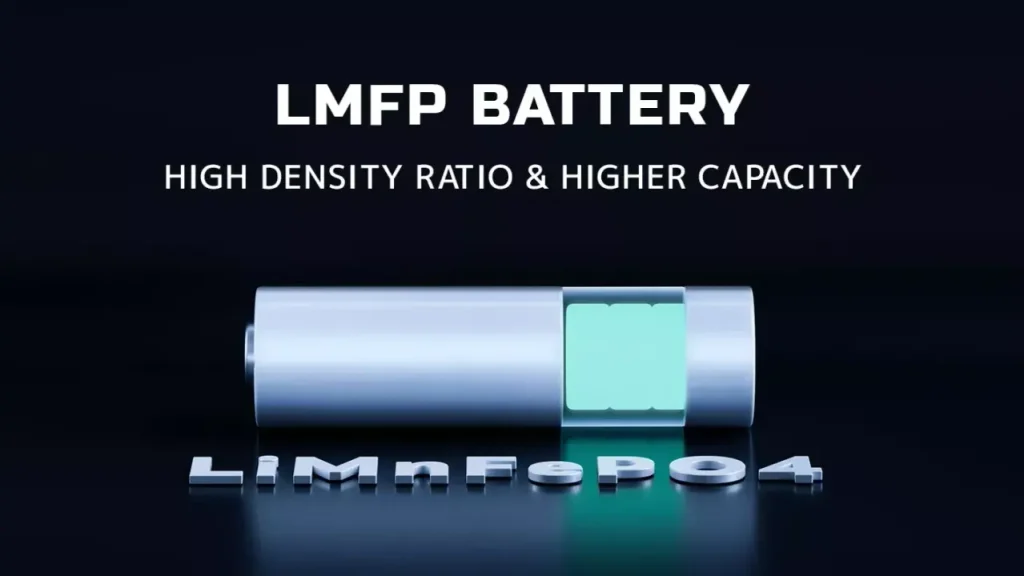
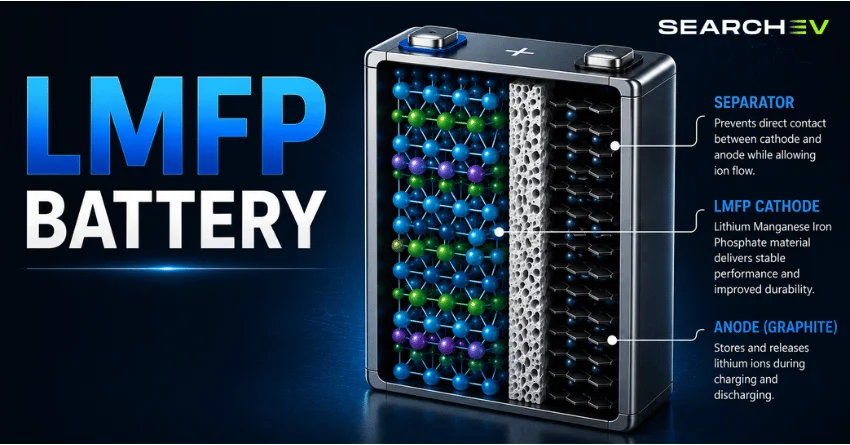
LMFP, or lithium manganese iron phosphate, has been getting a lot of attention in the power battery industry lately. By adding manganese to the LFP structure, the voltage platform rises from around 3.4V to about 4.1V, which boosts energy density while keeping the safety and cost advantages of lithium iron phosphate. For automakers trying to balance range and cost, LMFP looks like an attractive middle-ground option. But making high-quality LMFP cathode material depends heavily on the powder grinding step.
Why Particle Size Matters for LMFP
The particle size and distribution of cathode materials directly affect slurry coating, pressed density, and ultimately the battery’s rate capability and cycle life. Sintered LMFP is usually hard and tends to agglomerate, so it cannot be used directly in battery production. Typically, producers aim for a D50 between 1 and 5 microns with a narrow distribution, meaning the D90 to D10 ratio should not be too wide.
If the particles are too coarse, lithium-ion transport paths become longer. If the distribution is too wide, fine particles fill the gaps between larger ones. That may increase pressed density on paper, but it creates uneven porosity and poor electrolyte wetting, which hurts cell performance.
Why Jet Milling Fits LMFP
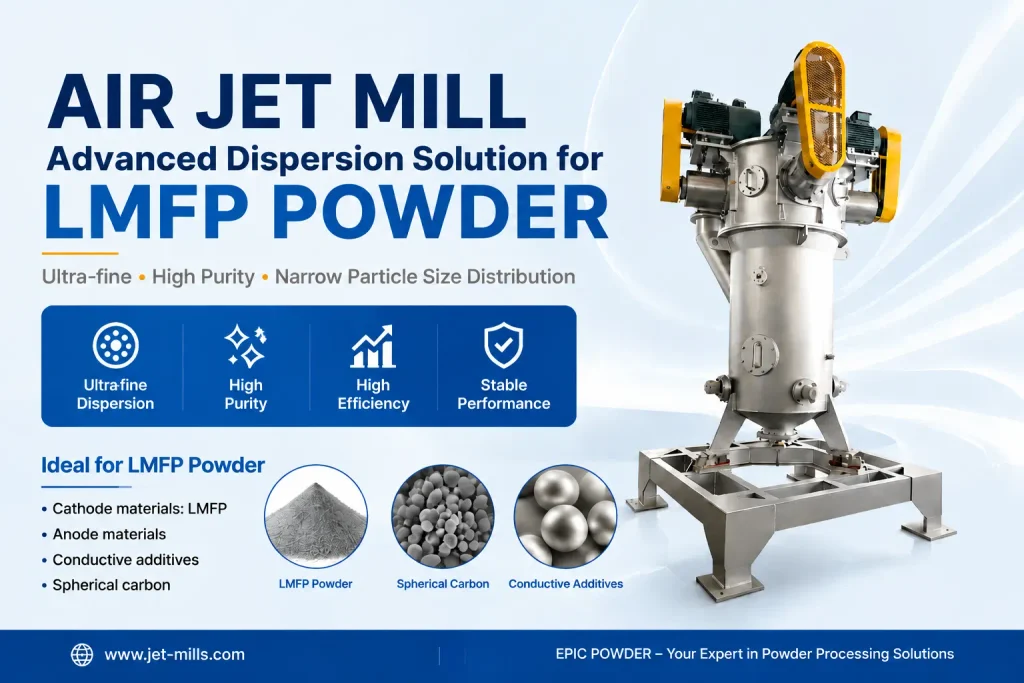
Strahlfräsen works well for hard, brittle cathode materials like LMFP. It uses high-speed airflow to accelerate particles and break them through particle-to-particle impact. Since there is no grinding media involved, metal contamination is minimal.
LMFP is highly sensitive to magnetic contaminants such as iron, chromium, and nickel. Even trace amounts can increase self-discharge and compromise battery safety. Jet mills with ceramic-lined or fully ceramic grinding chambers help keep this risk under control.
Avoiding Common Grinding Problems
Jet milling is not a set-and-forget process. The finer the LMFP powder, the higher its specific surface area and surface energy, which makes re-agglomeration more likely. If nozzle pressure, classifier speed, feed rate, and conveying airflow are not properly matched, the powder may pass the D50 test but still contain secondary agglomerates visible under SEM.
This is especially common during pilot trials. The classifier curve needs to be adjusted based on the sintering state and starting particle size of the raw material. The goal is to stabilize D50, D90, and specific surface area together, not just one number.
Moisture and Oxygen Control
Moisture control is another detail that cannot be overlooked. Like most cathode materials, LMFP is sensitive to humidity. If moisture gets into the powder during grinding, the surface state changes, which later affects viscosity and dispersion during carbon coating or slurry mixing.
That is why many LMFP grinding lines use a nitrogen closed-loop system. It keeps out moisture and oxygen while also reducing dust explosion risk. When evaluating equipment, pay close attention to airtightness, oxygen monitoring, and dust filter efficiency.
Equipment Selection for LMFP
Fluidized bed jet mills are widely used for LMFP grinding. The material is fluidized inside the grinding chamber, so particles collide more evenly and the finished powder has a more concentrated size distribution. For very fine targets, such as D50 below 2 microns, a multi-nozzle opposed-jet design can deliver more impact energy.
Classifier selection is also important. Different classifier designs and speed curves suit different target sizes, and the supplier usually matches them to the customer’s requirements.
How Epic Powder Supports LMFP Grinding
Taking Episches Pulver'S MQW series fluidized bed jet mill as an example, this equipment has been used in many battery material projects, including LFP, LCO, and ternary cathode materials. That experience transfers well to LMFP.
The grinding chamber can be lined with alumina or zirconia ceramic, and the classifier can also be fitted with ceramic parts to minimize metal contamination. For customers with strict moisture and oxygen limits, a nitrogen closed-loop system can keep oxygen levels very low and prevent powder moisture pickup.
For LMFP, which is still in process validation for many producers, we usually recommend starting with a lab-scale unit. Run a batch, confirm D50, D90, specific surface area, and impurity levels, then scale up once the process is stable.
LMFP Jet Milling in Practice
Fall 1:
A battery materials developer sent us a 5 kg batch of sintered LMFP powder that had been ground using a conventional mill. The D50 was around 8 microns, but the particle distribution was wide and SEM images showed dense agglomerates. The customer wanted to see if jet milling could bring the D50 below 3 microns while keeping magnetic impurities under 50 ppb.
We ran the test on a lab-scale MQW fluidized bed jet mill with a ceramic-lined grinding chamber and a nitrogen purge. After three rounds of parameter adjustment, the final powder reached a D50 of 2.3 microns, with D10 at 0.9 microns and D90 at 5.1 microns. The agglomerates were largely broken down, and magnetic impurity levels stayed well below the target. This gave the customer enough data to justify a pilot-scale unit.
Fall 2:
A cathode material producer in China was planning a new LMFP line and needed a grinding solution that could handle 500 kg per hour with stable particle size and low oxygen exposure. The target D50 was 2 to 4 microns, and the oxygen level during grinding had to stay below 100 ppm.
Based on the lab results, we recommended an MQW fluidized bed jet mill with a nitrogen closed-loop system, ceramic classifier, and automatic oxygen monitoring. After commissioning, the line ran at the target throughput with D50 consistently between 2.5 and 3.2 microns. The closed-loop system kept oxygen levels below 50 ppm, and the ceramic wear parts reduced metal contamination compared to the customer’s previous setup.
What to Look for When Buying a Jet Mill for LMFP
When purchasing a jet mill for LMFP, do not focus only on throughput. What matters more is whether the machine can consistently produce powder within specification, how well it controls metal contamination and magnetic particles, how reliable the inert gas protection system is, how easy it is to clean between batches, and whether the supplier has enough experience in battery materials.
LMFP behaves differently from LFP and NCM, so copying process parameters from other materials usually does not work.
Start with a Trial Run
If your LMFP project is hitting grinding bottlenecks, such as particle size that will not come down, a distribution that is too broad, serious agglomeration, or metal contamination exceeding limits, the best first step is a small-batch trial. Map the raw material behavior to the target specifications and equipment parameters before moving to production scale.
Epic Powder offers full support from lab test milling to complete line design. We can recommend the right machine and classifier configuration based on your product specifications. Send us your material, we run the test first, and then we discuss the solution. This approach reduces purchase risk and shortens commissioning time.
Episches Pulver
At Epic Powder, we offer a wide range of equipment models and tailor solutions to meet your specific needs. Our team has more than 20 years experience in various powders processing. Epic Powder is specialized in fine powder processing technology for mineral industry, chemical industry, food industry, pharama industry, etc.
Kontaktieren Sie uns Vereinbaren Sie noch heute einen Termin für eine kostenlose Beratung und individuelle Lösungen!

Vielen Dank fürs Lesen. Ich hoffe, mein Artikel war hilfreich. Hinterlassen Sie gerne einen Kommentar. Kontaktieren Sie EPIC Online-Kundendienstmitarbeiter von Powder Zelda „Für weitere Fragen.“
— Emily Chen, Ingenieur