
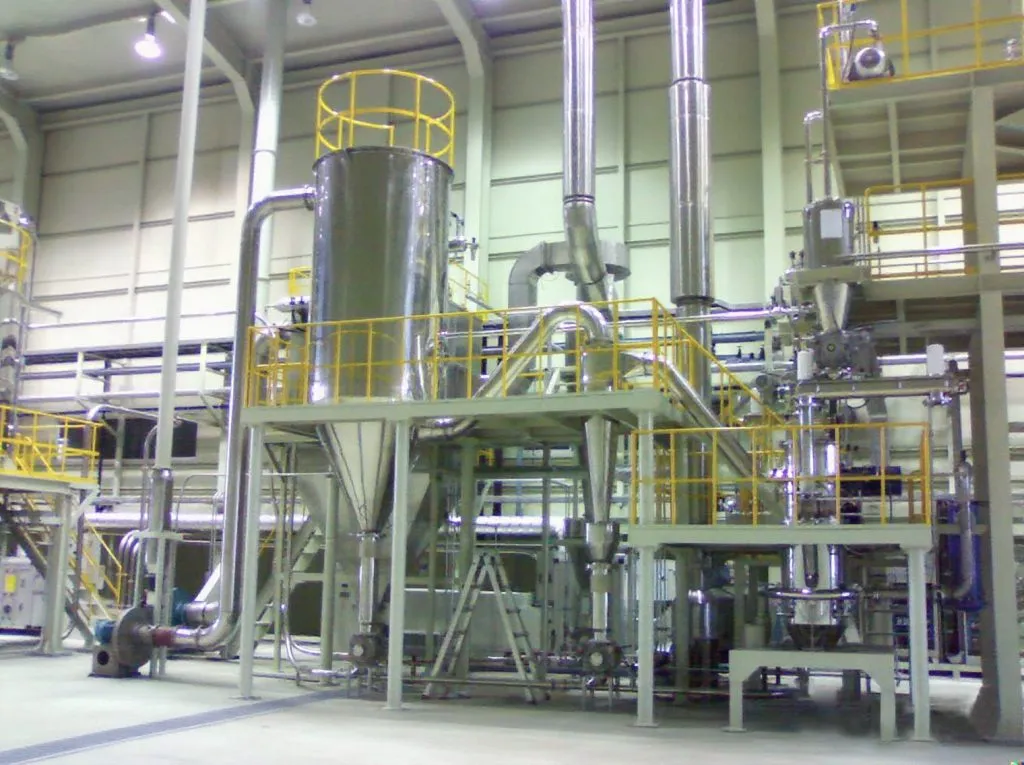
A cathode material supplier to a Korean electric vehicle group runs its ultrafine grinding on an Epic Powder MQW40 jet mill line. The line processes lithium iron phosphate (LFP) and single-crystal ternary material to D50 3.44 µm at 500 kg/h, and it has stayed in production long enough for the customer to sign a long-term supply agreement covering further capacity.
What Single-Crystal Cathode Powder Demands From a Mill
LFP and single-crystal ternary powders reach the mill after sintering, and each sintered cake must return to a fine, narrow powder without damaging what makes it valuable.
Single-crystal particles crack along grain boundaries when mills crush them against metal. Broken crystals expose new surfaces, and new surfaces mean extra lithium loss on the first charge. Cathode producers therefore buy grinding equipment on two numbers: the share of particles at target size, and the amount of metal the mill adds.
Heat adds a third constraint. Ternary cathode material reacts with moisture, so the mill must run cool and, on many lines, under dry inert gas.
The MQW40 Line Installed at the Plant
The customer selected the MQW40 fluidized bed jet mill during a capacity expansion. Material accelerates through LAVAL nozzles and grinds particle against particle in a fluidized bed. There is no grinding media, and the expanding gas keeps the process below ambient temperature without external cooling.
- Built-in horizontal classifier wheel with independent drive holds the cut point, so D50 stays near 3.44 µm while throughput changes between batches.
- Ceramic protection options on the lining, classifier wheel, and nozzles: alumina, zirconia, silicon carbide, or organic coating. The customer runs the configuration that suits its purity target.
- 316L contact surfaces, mirror polished and free of dead ends, for fast cleaning when the line switches between LFP and ternary batches.
- Closed-loop inert gas and explosion protection for fine cathode powder, which is combustible and moisture-sensitive.
Production Results
| Parameter | Value |
|---|---|
| Materials | Lithium iron phosphate, single-crystal ternary material |
| Equipment | MQW40 fluidized bed jet mill line |
| Particle size | D50 3.44 µm |
| Output | 500 kg/h |
Sizing a Jet Mill Line for Cathode Production
Planners comparing jet mill lines for LFP or ternary material can use this order of decisions, which is the order this project followed:
- Start from annual tonnage. Output near 500 kg/h on this material put the project on the MQW40. Smaller pilot lines map to MQW20 class units, and higher tonnage adds parallel lines rather than one oversized mill.
- Fix the purity budget next. Decide the allowed metal pickup first, then choose ceramic options on the lining, classifier wheel, and nozzles to meet it.
- Match the gas system to the material. Ternary material needs dry gas; fine LFP needs explosion protection sized to local code.
- Verify with your own powder. A trial grind on the same model that will be installed closes the gap between datasheet and plant reality.
The lithium battery material fluidized bed jet mill page lists the configurations built for cathode lines, and the fluidized bed jet mill range covers smaller and larger sizes. For pilot-scale verification, the laboratory fluidized bed jet mill runs the same grinding principle on a few kilograms of powder.
Send a sample of your LFP or ternary powder, and we will run the trial on the same model class and return a particle size distribution report with the offer. Trials are handled through the contact page.