
Global cobalt demand crossed 200,000 tonnes in 2024, with battery applications accounting for 76%. NCM hydroxide precursor, the downstream market for cobalt hydroxide, is projected to grow from USD 8.6 billion in 2025 to USD 24.3 billion by 2034 at a 12.2% CAGR. EV demand already accounts for about 61.7% of that market. Growth at this scale puts every step from mine to cathode under scrutiny. Deagglomeration is where good precursor can become a rejected batch. A Cobalt Hydroxide Реактивная мельница breaks agglomerates dry. No grinding media enters the product path, and the primary crystals stay as precipitation formed them.
The Key Concepts
Cobalt Hydroxide, Co(OH)₂
Cobalt(II) hydroxide is a transition metal hydroxide with amphoteric behavior. It dissolves in acid and in strong alkali, with its basic character the stronger of the two. It does not dissolve in water or ethanol. Density is about 3.597 g/cm³, and it decomposes on heating rather than melts, giving up water to form CoO.
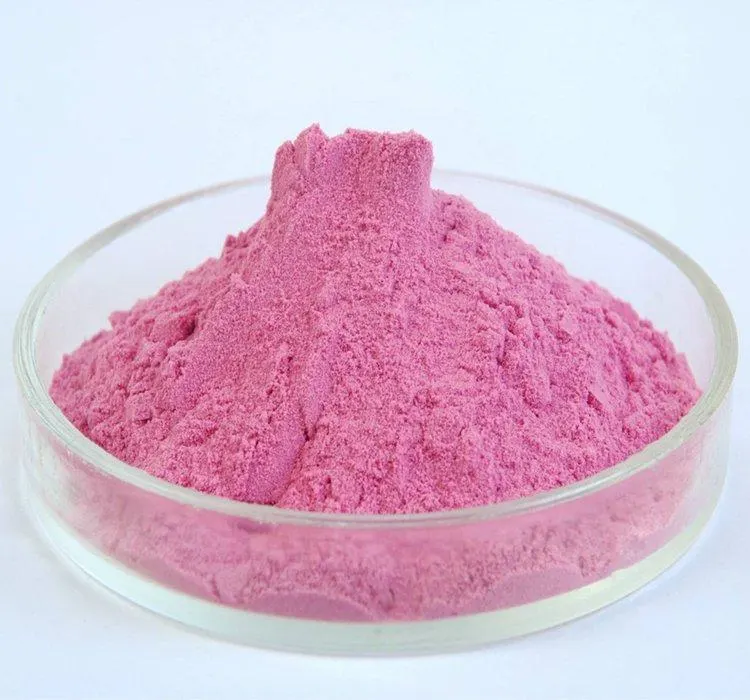
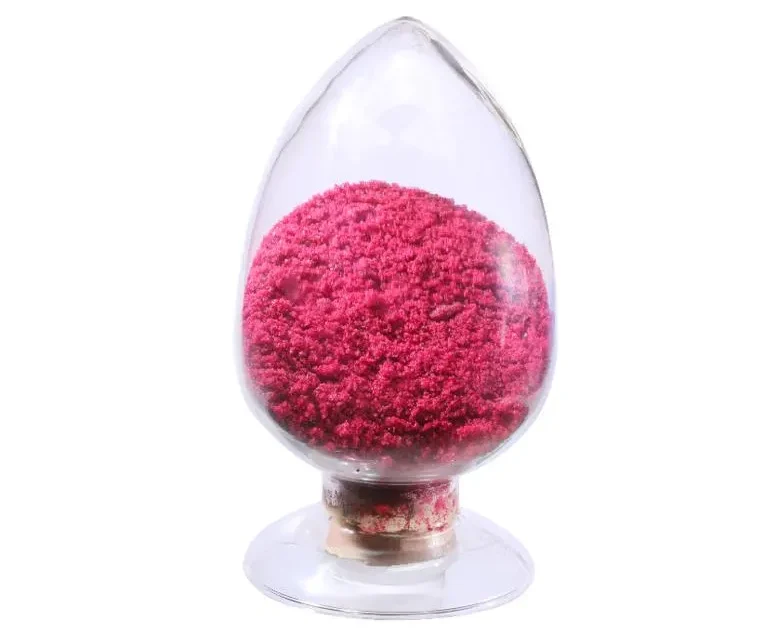
The material exists in two crystal phases. α-Co(OH)₂ has a hydrotalcite-like layered structure, usually appears blue-green, and conducts better than the β phase. It is metastable and converts to β under certain conditions. β-Co(OH)₂ has a brucite structure, usually appears rose-red or brick-red. It’s the thermodynamically stable phase. The colour in a sample bag depends on which phase dominates and on how much surface oxidation has occurred.
Where the Powder Comes From
Industrial production relies on chemical precipitation from cobalt salts under controlled pH, temperature, and feed rate, often with a complexing agent such as ammonia to set particle shape and purity. Electrolysis offers a second route with short flowsheets and high purity. Both routes deliver fine primary crystals with the size already set by the precipitation process. Neither route needs a mill to reduce primary crystal size.
What Drying Does
The wet precipitate cake goes to a dryer. Drying removes water down to under 0.5% moisture, and in the process it binds primary particles into agglomerates measuring 30–100 μm. These are not loose clusters. Contact points between primary crystals harden as the material cools. A feed in this state resists dispersion, does not flow uniformly into downstream equipment, and sits well above the particle size cathode precursor use requires.
What a Jet Mill Does
А струйная мельница accelerates feed particles in a high-velocity gas stream and lets them collide with each other. Compressed gas enters the grinding chamber through nozzles and drags particles into the collision zone. Particle-on-particle impact does the size reduction. An integrated classifier wheel holds coarse particles in the grinding zone and releases only powder that meets the cut point.
Two Questions About Jet Milling Cobalt Hydroxide
Question 1: Will the mill change the crystal phase or the primary crystal size?
No, on both counts. An agglomerate entering the collision zone absorbs a distributed load, and the weak contact points between primary crystals break first. The primary crystals separate with far less fracture than a hammer mill or media mill produces. The process does not change the crystal phase either: α-Co(OH)₂ that enters the mill leaves as α-Co(OH)₂, and storage and drying history, not grinding, set the α-to-β ratio. The mill separates particles that drying joined together, and it stops there.
Question 2: Why not keep the hammer mill, or switch to wet grinding?
Each alternative fails on a different axis. Hammers, screens, and mill liners wear, and that wear reports to the product as iron, chromium, and other metals. In NCM and NCA cathodes, cobalt stabilizes the layered structure and suppresses cation mixing, so metal pushed in at the deagglomeration step travels downstream, where removal costs more at every later stage. Metal contamination in finished cathode material can lead to short circuiting in the cell. Wet grinding avoids the hammer wear but adds water and a second drying step. The second dryer costs energy, and the material coming out of it cakes again, restarting the agglomeration cycle. Water also feeds the oxidation problem: in alkaline conditions Co(OH)₂ turns to brown Co(OH)₃ in air or with a weak oxidizer.
The Benefits of the Jet Mill Route
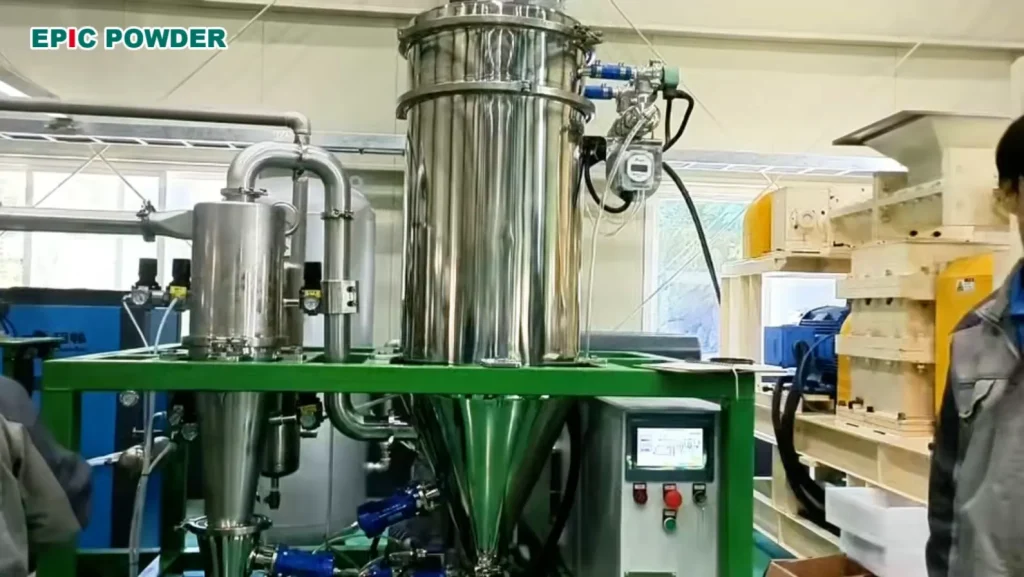
A metal-free product path. No grinding media touches the powder, and ceramic protection covers the chamber, nozzles, and classifier wheel. The mill adds no metal of its own, which protects the impurity budget instead of spending it. Эпический порошок builds a dedicated lithium battery material fluidized bed jet mill on the same platform for precursor and cathode work.
One dry step, no second dryer. The feed arrives at under 0.5% moisture and leaves as dispersed powder. No water enters the process, so no re-caking cycle exists.
Agglomerate-only fracture. The mill breaks the weak bonds that drying created and leaves the precipitation-set primary crystals and the crystal phase untouched.
Adjustable cut point from the control panel. The same machine holds a target D50 across feed lots, with no screen swap or mechanical change between grades.
An inert gas closed-loop option. The inert gas spiral jet mill runs a closed loop that keeps dried Co(OH)₂ from picking up moisture and limits oxidation during handling.
Closed dust handling for a toxic material. Inhalation of cobalt compound dust can cause bronchial asthma, and skin contact can lead to dermatitis. A closed milling system with dust collection limits operator exposure at the feed inlet and product discharge.
Have dried cobalt hydroxide on hand? Send a 1–2 kg sample of your actual feed to Epic Powder’s test center. We grind it on the MQW03, measure particle size, moisture, and phase before and after, and return a trial report with the figures your procurement team needs. Start a trial →
How to Run It, Step by Step
Step 1: Dry the feed below 0.5% moisture. Stickiness above this level cakes on classifier wheels and discharge lines. The dryer sits upstream of the mill in the complete line.
Step 2: Start with a representative sample and full characterization. Measure particle size, aluminum, moisture, and crystal phase before grinding, on material taken from the actual dryer output. Kilogram-scale validation on the лабораторная струйная мельница reproduces production behavior before a full-scale trial.
Step 3: Set the cut point from the control panel. Specify the target D50 for the precursor application, and let the classifier hold that window across the run.
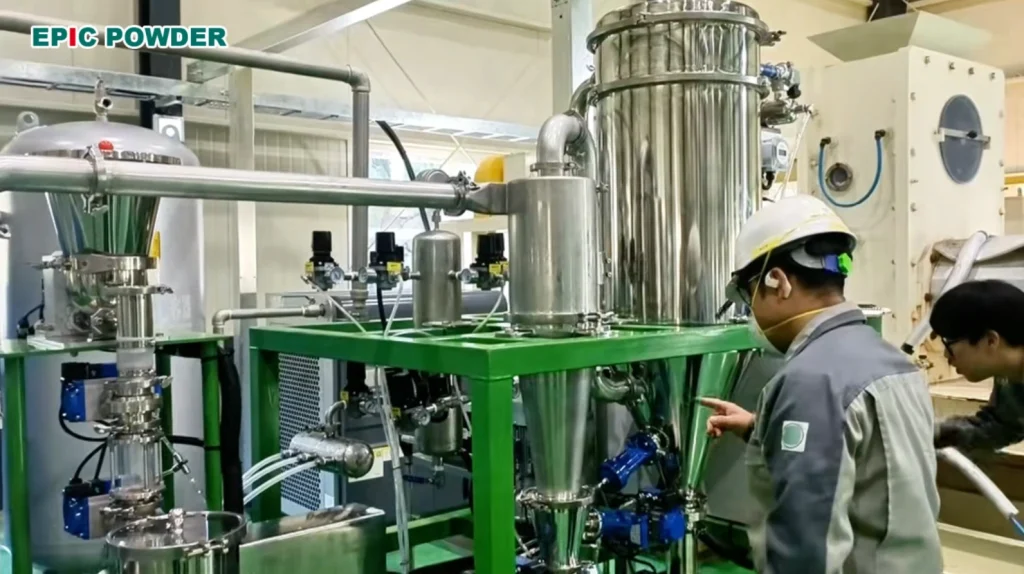
Step 4: Grind in the fluidized bed. In the MQW03 горизонтальная струйная мельница с псевдоожиженным слоем, compressed gas passes through a Laval nozzle into the chamber at high speed. Multiple gas jets intersect, and the feed particles collide, rub, and shear against each other. The weak inter-crystal bonds break; the crystals survive.
Step 5: Classify. The upward gas flow carries the ground material to the rotating classifier wheel, which separates fine from coarse by centrifugal force. Coarse particles return to the grinding zone; product at the cut point exits to the cyclone and filter.
Step 6: Collect in a closed system. Dust collection at the inlet and discharge keeps operator exposure down, and the closed loop keeps the dried powder from re-absorbing moisture.
Step 7: Verify and scale. Measure particle size, aluminum, moisture, and phase after grinding against the before-values. For scale-up, the MQW series covers models from MQW03 to MQW240, from laboratory batches to production volumes, and Epic Powder runs trial grinding on customer samples before equipment selection, so capacity and fineness figures come from the actual feed.
A Project Case in Korea:
The feed was dried cobalt hydroxide at < 0.5% moisture, leaving the dryer as hard agglomerates of 30–100 μm. After grinding in the MQW03, the product held D50 10–15 μm. The fracture stayed at the weak inter-crystal bonds: primary crystals set by precipitation kept their size, the α-to-β phase ratio survived the pass unchanged, and the chemical composition showed no drift. A Korean battery materials producer ran this trial on its own feed and purchased the MQW03 on the strength of these figures.
| Элемент | Data |
|---|---|
| Размер корма | 30–100 μm, agglomerated after drying |
| Влажность корма | < 0.5% |
| Product fineness | D50 10–15 μm |
| Оборудование | MQW03 horizontal fluidized bed jet mill |
Эпический порошок
Компания Epic Powder разрабатывает системы измельчения и классификации для минералов, химикатов, продуктов питания и фармацевтических препаратов. Обладая более чем 20-летним опытом в области обработки порошков, мы подбираем мельницу, соответствующую требуемому размеру частиц и производительности.
Контакт Эпический порошок for the MQW03 data sheet and the cobalt hydroxide trial report. Send us a message and we reply within 24 hours, or write to mineral@epic-powder.com. The full equipment range, from струйные мельницы с псевдоожиженным слоем to spiral jet mills and laboratory units, is listed on the products page.

Спасибо за прочтение. Надеюсь, моя статья вам поможет. Пожалуйста, оставьте комментарий ниже. Вы также можете свяжитесь с EPIC Представитель по работе с клиентами Powder Online Molly для любых дальнейших запросов».
— Джейсон Ван, Инженер