
Graphite powder is a non-metallic mineral material with multiple inherent properties like electrical conductivity, self-lubrication, and high-temperature resistance. Differences in carbon content, crystal structure, and particle size distribution result in distinctly different functional performances across product grades. For manufacturers in the battery, metallurgy, coatings, and composites industries, understanding these differences is the key to selecting the right material for the right application. Equally important is the processing technology that transforms raw graphite into high-performance powders, which is where EPİK Tozu‘s fluid energy jet değirmeni solutions come into play.
What Are the Core Functional Highlights of Graphite Powder?
The functional properties of graphite powder are directly determined by three parameters: carbon content (purity), crystal structure (flake vs. amorphous), and particle size distribution. Currently, mainstream graphite powder products on the market deliver value across three core functional dimensions:
1. Electrical Conductivity
Graphite powder with a carbon content of 99% or higher can be used as a conductive filler in battery electrodes, conductive coatings, anti-static materials, and electronic components. By forming a conductive network within the composite material, it effectively reduces the material‘s electrical resistivity. Graphite’s conductivity is significantly higher than that of most other non-metallic minerals.
2. Lubrication
Flake-structured graphite powder maintains stable lubricating performance even under high-temperature operating conditions—well beyond the failure temperature of conventional liquid lubricants. The larger the flake size, the lower the coefficient of friction and the better the lubrication performance. This makes graphite powder an ideal solid lubricant alternative in metallurgy, mechanical processing, and high-temperature friction applications.
3. High-Temperature Resistance
With a melting point exceeding 3,600°C (up to 3,697°C in some grades), graphite powder can be added to refractory materials as a performance enhancer. It can improve the high-temperature stability, thermal shock resistance, and corrosion resistance of finished products. This property is particularly valuable in advanced refractories, crucibles, and high-temperature sealing materials.
The Role of Fluid Energy Jet Milling in Graphite Processing
bu fluid energy jet mill, also known as an airflow pulverizer, is one of the most important ultrafine grinding equipment in the powder processing industry. Unlike traditional mills with rotating blades or grinding media, jet değirmenleri rely on high-velocity jets of compressed gas (typically air or nitrogen) to grind and disperse particles into fine powders.
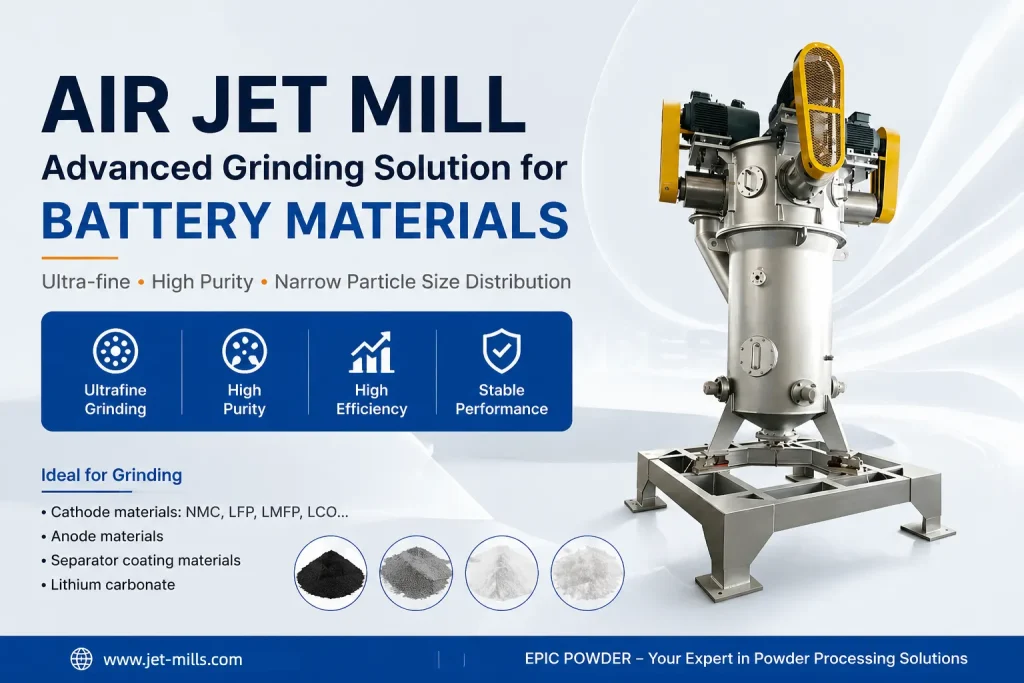
EPIC Powder’s MQW Series Fluidized Bed Jet Mill‘s core advantages for graphite processing include:
Self-grinding mechanism: Particles collide with each other at supersonic speeds, eliminating secondary metallic contamination—a critical advantage for high-purity applications.
Integrated precision classification: The horizontal high-speed classifying wheel enables precise control over particle size distribution (PSD), achieving D97 as fine as 3–5 μm.
Düşük sıcaklıkta öğütme: The Joule-Thomson cooling effect from expanding compressed gas offsets heat generation, protecting the crystalline structure of graphite.
Contamination-free operation: With no mechanical moving parts contacting the material, jet milling keeps metallic impurities well below the stringent limits required for battery-grade materials—often below 10 ppm.
For graphite micronization, the fluid energy jet mill is the preferred technique because it can delaminate and refine flake graphite without damaging its crystalline structure, thereby preserving its crucial electrical and thermal properties.
What Are the Functional Differences Between Graphite Powder Grades?
Graphite powder products can be categorized by carbon content, purity level, and processing technology. Each category delivers distinct functional advantages for specific applications.
| Seviye | Carbon Content | Key Functional Highlights | Tipik Uygulamalar |
|---|---|---|---|
| Medium Carbon Graphite Powder | 80%–94% | Cost-effective; basic lubricating and high-temperature resistance properties | Casting mold release agents; metallurgical refractories |
| High Carbon Graphite Powder | 94%–99% | Stable electrical conductivity; low impurity content | Conductive coatings; conventional battery electrodes |
| High Purity Graphite Powder | ≥99.9% | Chemically stable; impurities <100 ppm (down to <10 ppm for specialized grades) | Lithium-ion battery anodes; semiconductor industry |
| High Purity Carbon Nanotubes | One-dimensional nanostructure | Exceptional electrical and thermal conductivity; high mechanical strength | Battery conductive additives; composite material reinforcement phases |
Taking medium-carbon graphite powder, high-carbon graphite powder, and high-purity carbon nanotubes as examples, EPİK Tozu has developed continuous high-temperature vacuum furnace purification equipment. This technology, combined with a continuous high-temperature + vacuum + pulse oscillation purification production line, enables precise parameter control across different graphite powder grades. The related technologies are protected by 7 invention patents Ve 8 utility model patents.
To achieve the ultrafine particle sizes required for high-end applications, EPIC Powder’s MQW Series fluidized bed jet mill delivers precise micronization with a narrow particle size distribution—a critical factor for optimizing lithium-ion battery electrode materials. In actual production, the MQW Series has achieved finished product D97 as fine as 3.76 μm for natural graphite, with intact flake structure and excellent dispersibility.
What Is the Practical Application Value of Graphite Powder?
The functional properties of graphite powder make it irreplaceable across multiple industrial sectors. The core application value is in three main areas:
1. Reducing Industrial Energy Consumption
In the metallurgical industry, refractory materials containing graphite powder additives improve kiln thermal efficiency and reduce heat loss. Industry data indicates that such applications can lower energy consumption in relevant processes by approximately 8%–12%. This not only reduces operating costs but also supports sustainability initiatives in energy-intensive industries.
2. Enhancing Product Performance
Adding high-purity graphite powder and high-purity carbon nanotubes to lithium-ion battery anode materials improves charge-discharge efficiency and cycle life. This approach has become the mainstream technical pathway for power lithium-ion batteries, driven by the rapid growth of the new energy vehicle industry.
Here, jet freze plays a pivotal role: for graphite anode materials, particle size controls the balance between energy density (favouring larger particles with higher tap density) and rate capability (favouring smaller particles with shorter lithium diffusion paths). EPIC Powder‘s fluid energy jet mills enable precise D50 control—typically 10–20 μm for commercial anode graphite, and 5–12 μm for fast-charge applications.
3. Extending Equipment Service Life
Using graphite powder as a lubricating medium under high-temperature friction conditions avoids the high-temperature failure issues of traditional lubricating oils. In practice, this can extend equipment component service life by 2–3 times, significantly reducing maintenance costs and downtime.
Market Outlook
According to industry reports, the global graphite powder market was valued at approximately USD 4.1 billion in 2025 ve ulaşması öngörülüyor USD 7.3 billion by 2035, growing at a CAGR of 6.7%. The broader graphite market is expected to grow from USD 16.94 billion in 2025 to USD 28.31 billion by 2032, with a CAGR of 7.60%.
With the continued expansion of new energy, semiconductor, and advanced materials industries, the demand for high-purity and specialty-performance graphite powder products is expected to maintain an average annual growth rate of over 15%. Customized graphite powder products with enhanced functional adaptability will become the industry‘s development direction.
Sıkça Sorulan Sorular
Q: What is the electrical conductivity range of graphite powder?
A: Conventional graphite powder exhibits an electrical conductivity of 10³–10⁴ S/m, while high-purity products can reach 10⁵ S/m or higher.
Q: Can graphite powder be lubricating material?
A: Yes. Graphite powder outperforms traditional lubricating oils under high-temperature conditions above 400°C, maintaining stable lubrication where liquid lubricants would fail.
Q: What are the impurity content requirements for high-purity graphite powder?
A: Standard high-purity graphite powder has an impurity content below 100 ppm. For specialized applications, impurity levels can be lower than 10 ppm.
Q: How does particle size affect graphite powder performance?
A: Particle size directly influences conductivity, lubrication, and dispersion characteristics. Finer particles generally provide better surface coverage and uniformity, while larger flake sizes offer superior lubricating properties. Jet milling enables precise control over these parameters.
EPİK Tozu
Şu anda EPİK Tozu, we combine advanced fluid energy jet mill technology with proprietary purification processes to deliver graphite powder solutions tailored to your specific application requirements.
Bizim MQW Serisi Akışkan Yataklı Jet Değirmeni offers:
Particle-on-particle grinding: Eliminates media contamination, preserving material purity
Built-in precision classification: Horizontal classifying wheels ensure narrow particle size distribution with D97 down to 3–5 μm
Low-temperature operation: Protects heat-sensitive and crystalline materials
Inert gas closed-circuit design: Available for flammable, explosive, or oxidation-sensitive materials
Scalable production: Capacities ranging from several kilograms to several tons per hour
Whether you need medium-carbon graphite for cost-effective refractories, high-purity graphite for battery anodes, or carbon nanotubes for advanced composites, EPIC Powder provides the processing expertise and manufacturing capability to meet your specifications.
Bize Ulaşın Bugün to discuss your graphite powder requirements, or explore our product pages to learn more about our fluid energy jet mill and purification solutions.

"Okuduğunuz için teşekkürler. Umarım makalem yardımcı olur. Lütfen aşağıya yorum bırakın. Ayrıca şunları da yapabilirsiniz: EPIC ile iletişime geçin Toz çevrimiçi müşteri temsilcisi Zelda Daha fazla bilgi için bize ulaşın.”
— Jason Wang, Mühendis