
El polvo de grafito es un material mineral no metálico con múltiples propiedades inherentes, como conductividad eléctrica, autolubricación y resistencia a altas temperaturas. Las diferencias en el contenido de carbono, la estructura cristalina y la distribución del tamaño de partícula dan como resultado rendimientos funcionales claramente diferentes entre los distintos grados de producto. Para los fabricantes de las industrias de baterías, metalurgia, recubrimientos y materiales compuestos, comprender estas diferencias es clave para seleccionar el material adecuado para la aplicación correcta. Igualmente importante es la tecnología de procesamiento que transforma el grafito en bruto en polvos de alto rendimiento, que es donde Polvo Épico‘'‘energía fluida molino de chorro Las soluciones entran en juego.
¿Cuáles son las principales características funcionales del polvo de grafito?
Las propiedades funcionales del polvo de grafito están determinadas directamente por tres parámetros: contenido de carbono (pureza), estructura cristalina (en láminas frente a amorfa) y distribución del tamaño de partícula. Actualmente, los productos de polvo de grafito convencionales en el mercado ofrecen valor en tres dimensiones funcionales principales:
1. Conductividad eléctrica
El polvo de grafito con un contenido de carbono de 99% o superior puede utilizarse como relleno conductor en electrodos de baterías, recubrimientos conductores, materiales antiestáticos y componentes electrónicos. Al formar una red conductora dentro del material compuesto, reduce eficazmente su resistividad eléctrica. La conductividad del grafito es significativamente mayor que la de la mayoría de los demás minerales no metálicos.
2. Lubricación
El polvo de grafito con estructura laminar mantiene un rendimiento lubricante estable incluso en condiciones de alta temperatura, muy por encima de la temperatura de fallo de los lubricantes líquidos convencionales. Cuanto mayor sea el tamaño de las partículas, menor será el coeficiente de fricción y mejor el rendimiento de la lubricación. Esto convierte al polvo de grafito en una alternativa ideal como lubricante sólido en metalurgia, procesos mecánicos y aplicaciones de fricción a altas temperaturas.
3. Resistencia a altas temperaturas
Con un punto de fusión superior a 3600 °C (hasta 3697 °C en algunos grados), el polvo de grafito puede añadirse a materiales refractarios para mejorar su rendimiento. Mejora la estabilidad a altas temperaturas, la resistencia al choque térmico y la resistencia a la corrosión de los productos terminados. Esta propiedad es especialmente valiosa en refractarios avanzados, crisoles y materiales de sellado para altas temperaturas.
El papel del fresado por chorro de energía fluida en el procesamiento del grafito
El molino de chorro de energía fluida, también conocido como pulverizador de flujo de aire, es uno de los equipos de molienda ultrafina más importantes en la industria del procesamiento de polvos. A diferencia de los molinos tradicionales con cuchillas giratorias o medios de molienda, molinos de chorro Se basan en chorros de gas comprimido a alta velocidad (normalmente aire o nitrógeno) para moler y dispersar las partículas hasta convertirlas en polvos finos.
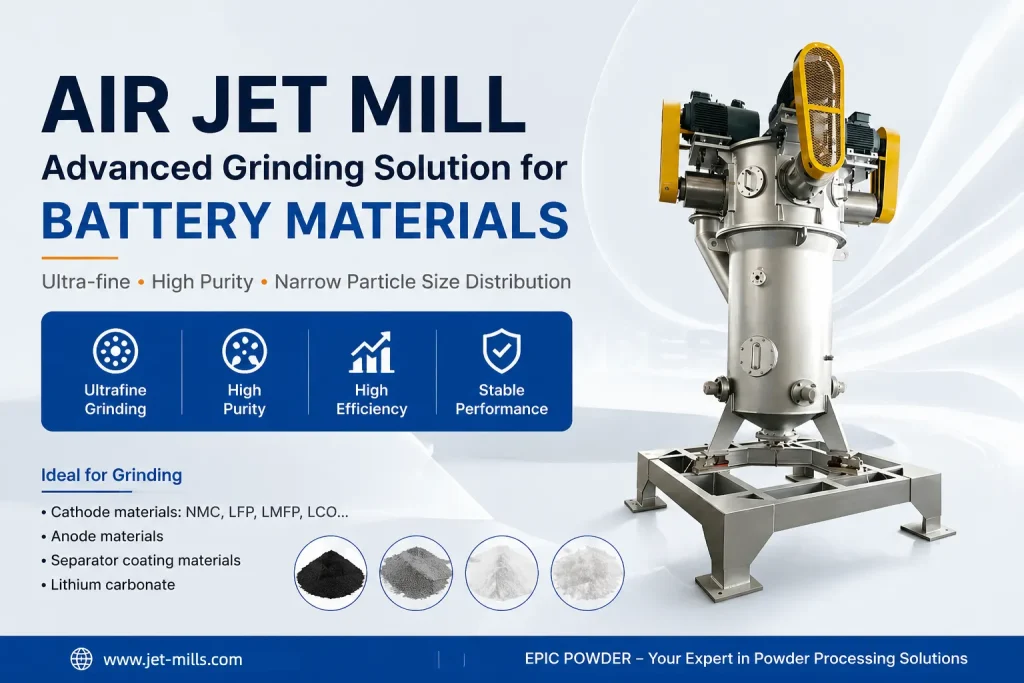
Molino de chorro de lecho fluidizado serie MQW de EPIC Powder‘Las principales ventajas de para el procesamiento del grafito incluyen:
Mecanismo de autoafiladoLas partículas colisionan entre sí a velocidades supersónicas, eliminando la contaminación metálica secundaria, una ventaja fundamental para aplicaciones de alta pureza.
Clasificación de precisión integradaLa rueda clasificadora horizontal de alta velocidad permite un control preciso de la distribución del tamaño de partícula (PSD), logrando un D97 de tan solo 3–5 μm.
Molienda a baja temperaturaEl efecto de enfriamiento Joule-Thomson producido por la expansión del gas comprimido compensa la generación de calor, protegiendo la estructura cristalina del grafito.
Funcionamiento libre de contaminaciónAl no haber piezas mecánicas móviles en contacto con el material, la molienda por chorro mantiene las impurezas metálicas muy por debajo de los estrictos límites requeridos para los materiales aptos para baterías, a menudo por debajo de 10 ppm.
Para la micronización del grafito, el molino de chorro de energía fluida Es la técnica preferida porque permite delaminar y refinar el grafito en escamas sin dañar su estructura cristalina, preservando así sus cruciales propiedades eléctricas y térmicas.
¿Cuáles son las diferencias funcionales entre los distintos grados de polvo de grafito?
Los productos de grafito en polvo se pueden clasificar según su contenido de carbono, nivel de pureza y tecnología de procesamiento. Cada categoría ofrece ventajas funcionales específicas para distintas aplicaciones.
| Calificación | Contenido de carbono | Aspectos funcionales clave | Aplicaciones típicas |
|---|---|---|---|
| Polvo de grafito de carbono medio | 80%–94% | Rentable; propiedades básicas de lubricación y resistencia a altas temperaturas. | Agentes desmoldantes para fundición; refractarios metalúrgicos |
| Polvo de grafito con alto contenido de carbono | 94%–99% | Conductividad eléctrica estable; bajo contenido de impurezas. | Recubrimientos conductores; electrodos de baterías convencionales |
| Polvo de grafito de alta pureza | ≥99,9% | Químicamente estable; impurezas <100 ppm (hasta <10 ppm para grados especializados). | Ánodos de baterías de iones de litio; industria de semiconductores |
| Nanotubos de carbono de alta pureza | Nanoestructura unidimensional | Conductividad eléctrica y térmica excepcionales; alta resistencia mecánica. | Aditivos conductores para baterías; fases de refuerzo de materiales compuestos |
Tomando como ejemplos el polvo de grafito de carbono medio, el polvo de grafito de alto carbono y los nanotubos de carbono de alta pureza, Polvo Épico ha desarrollado un equipo de purificación de horno de vacío de alta temperatura continua. Esta tecnología, combinada con una línea de producción de purificación continua de alta temperatura + vacío + oscilación pulsada, permite un control preciso de los parámetros en diferentes grados de polvo de grafito. Las tecnologías relacionadas están protegidas por 7 patentes de invención y 8 patentes de modelos de utilidad.
Para lograr los tamaños de partículas ultrafinos requeridos para aplicaciones de alta gama, EPIC Powder utiliza Molino de chorro de lecho fluidizado serie MQW Ofrece una micronización precisa con una distribución estrecha del tamaño de partícula, un factor crítico para optimizar los materiales de los electrodos de las baterías de iones de litio. En la producción real, la serie MQW ha logrado un producto final D97 de tan solo 3,76 μm para el grafito natural, con una estructura laminar intacta y una excelente dispersibilidad.
¿Cuál es el valor práctico del polvo de grafito?
Las propiedades funcionales del polvo de grafito lo hacen insustituible en múltiples sectores industriales. Su principal valor de aplicación reside en tres áreas principales:
1. Reducción del consumo energético industrial
En la industria metalúrgica, los materiales refractarios que contienen aditivos de polvo de grafito mejoran la eficiencia térmica del horno y reducen la pérdida de calor. Los datos de la industria indican que dichas aplicaciones pueden reducir el consumo de energía en los procesos relevantes en aproximadamente 8%–12%. Esto no solo reduce los costos operativos, sino que también apoya las iniciativas de sostenibilidad en las industrias con alto consumo energético.
2. Mejora del rendimiento del producto
La adición de polvo de grafito de alta pureza y nanotubos de carbono de alta pureza a los materiales del ánodo de las baterías de iones de litio mejora la eficiencia de carga y descarga, así como la vida útil. Este enfoque se ha convertido en la principal vía técnica para las baterías de iones de litio de alta potencia, impulsado por el rápido crecimiento de la industria de los vehículos de nueva energía.
Aquí, fresado por chorro Desempeña un papel fundamental: en los materiales de ánodo de grafito, el tamaño de partícula controla el equilibrio entre la densidad de energía (favoreciendo partículas más grandes con mayor densidad aparente) y la capacidad de velocidad de carga/descarga (favoreciendo partículas más pequeñas con trayectorias de difusión de litio más cortas). Los molinos de chorro de energía fluida de EPIC Powder permiten un control preciso del D50, típicamente de 10 a 20 μm para grafito de ánodo comercial y de 5 a 12 μm para aplicaciones de carga rápida.
3. Prolongación de la vida útil de los equipos
El uso de polvo de grafito como medio lubricante en condiciones de fricción a alta temperatura evita los problemas de fallas a alta temperatura de los aceites lubricantes tradicionales. En la práctica, esto puede extender la vida útil de los componentes del equipo mediante 2-3 veces, reduciendo significativamente los costos de mantenimiento y el tiempo de inactividad.
Perspectivas del mercado
Según informes de la industria, el mercado mundial de polvo de grafito estaba valorado en aproximadamente 4.100 millones de dólares en 2025 y se prevé que alcance 7.300 millones de dólares para 2035, creciendo a un ritmo CAGR de 6,7%. Se espera que el mercado más amplio del grafito crezca desde De 16.940 millones de dólares en 2025 a 28.310 millones de dólares en 2032., con una CAGR de 7,60%.
Con la continua expansión de las industrias de energías renovables, semiconductores y materiales avanzados, se espera que la demanda de productos de polvo de grafito de alta pureza y rendimiento especial se mantenga. tasa de crecimiento anual promedio de más de 15%. Los productos de polvo de grafito personalizados con una adaptabilidad funcional mejorada se convertirán en la dirección de desarrollo de la industria.
Preguntas frecuentes
P: ¿Cuál es el rango de conductividad eléctrica del polvo de grafito?
A: El polvo de grafito convencional presenta una conductividad eléctrica de 10³–10⁴ S/m, mientras que los productos de alta pureza pueden alcanzar 10⁵ S/m o más.
P: ¿Puede el polvo de grafito utilizarse como material lubricante?
R: Sí. El polvo de grafito supera a los aceites lubricantes tradicionales en condiciones de alta temperatura, por encima de los 400 °C, manteniendo una lubricación estable donde los lubricantes líquidos fallarían.
P: ¿Cuáles son los requisitos de contenido de impurezas para el polvo de grafito de alta pureza?
A: El grafito en polvo estándar de alta pureza tiene un contenido de impurezas inferior a 100 ppm. Para aplicaciones especializadas, los niveles de impurezas pueden ser inferiores a 10 ppm.
P: ¿Cómo afecta el tamaño de las partículas al rendimiento del polvo de grafito?
A: El tamaño de partícula influye directamente en la conductividad, la lubricación y las características de dispersión. Las partículas más finas generalmente proporcionan una mejor cobertura superficial y uniformidad, mientras que las partículas de mayor tamaño ofrecen propiedades lubricantes superiores. La molienda por chorro permite un control preciso de estos parámetros.
Polvo Épico
En Polvo Épico, combinamos tecnología avanzada molino de chorro de energía fluida Tecnología con procesos de purificación patentados para ofrecer soluciones de polvo de grafito adaptadas a las necesidades específicas de su aplicación.
Nuestro Molino de chorro de lecho fluidizado serie MQW ofrece:
Molienda partícula sobre partículaElimina la contaminación del medio, preservando la pureza del material.
Clasificación de precisión integrada: Las ruedas de clasificación horizontales aseguran una distribución estrecha del tamaño de partícula con D97 de hasta 3–5 μm.
Funcionamiento a baja temperaturaProtege materiales sensibles al calor y cristalinos.
Diseño de circuito cerrado de gas inerteDisponible para materiales inflamables, explosivos o sensibles a la oxidación.
Producción escalableCapacidades que van desde varios kilogramos hasta varias toneladas por hora.
Tanto si necesita grafito de carbono medio para refractarios económicos, grafito de alta pureza para ánodos de baterías o nanotubos de carbono para compuestos avanzados, EPIC Powder le ofrece la experiencia en procesamiento y la capacidad de fabricación necesarias para cumplir con sus especificaciones.
Contáctenos hoy para hablar sobre sus necesidades de polvo de grafito, o explore nuestras páginas de productos para obtener más información sobre nuestros productos. molino de chorro de energía fluida y soluciones de purificación.

Gracias por leer. Espero que mi artículo te haya sido útil. Deja un comentario abajo. También puedes Contacta con EPIC Representante de atención al cliente en línea de Powder Zelda para cualquier otra consulta.
— Jason Wang, Ingeniero