
Both machines grind particle-on-particle in a high-velocity gas stream without grinding media. Both hit the D97 2 to 45 µm window on brittle feeds. Yet the مطحنة نفاثة حلزونية and the طاحونة نفاثة ذات سرير مائع belong in very different plants. Batch size, cut sharpness, and cleaning turnaround split the two designs. The target D97 alone does not.
How Each Design Grades the Product
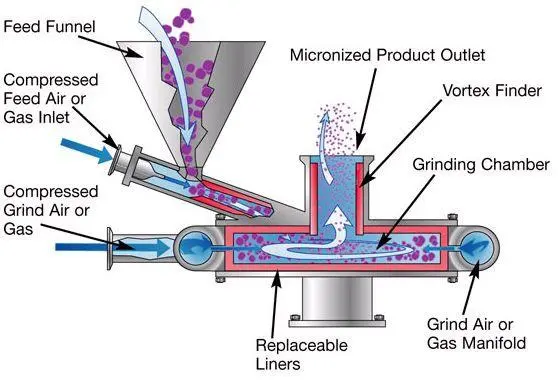
أ مطحنة نفاثة حلزونية uses a flat, circular chamber with zero moving parts. Tangential nozzles accelerate gas along the perimeter wall. Centrifugal force holds coarse particles at the rim. Fines small enough for the inward gas drag exit through the central outlet. The cut point is static, and the chamber geometry sets it. Because no moving parts contact the powder, the chamber liner is the only wear component.
A fluidized bed jet mill expands the feed upward on a bottom gas distributor. Opposed nozzles create the central grinding zone. Above the bed, a rotating turbine wheel classifies the rising powder. Because wheel speed is adjustable via frequency inverter, operators shift the cut on the fly without opening the chamber. Coarse particles reject back into the grinding zone and exit only once they reach target fineness.
Batch Size and Economics
Throughput scale is the first divider. A spiral jet mill excels at R&D lots and small-to-medium batches (typically about 0.1 to 200 kg/h). Its simple chamber costs less to fabricate and takes minutes to strip down. Pharmaceutical, specialty chemical, and laboratory lines rely on this geometry, and our spiral jet mill range covers all three. A laboratory spiral jet mill mirrors the exact aspect ratio of production units, keeping scale-up predictable.
The fluidized bed design targets continuous, multi-tonnage production (typically about 50 to 5,000 kg/h). Because the dynamic wheel immediately evacuates finished fines, over-grinding stays low and the specific energy per ton drops. At industrial tonnage, those compressor savings pay back the higher capital cost. ملكنا دليل تحسين استهلاك الطاقة details where those compressed-gas savings come from.
Distribution Width and Over-grinding
Static aerodynamic classification grades less sharply than a mechanical turbine wheel. Consequently, a spiral jet mill produces a wider particle size distribution (PSD). Some fines linger in the grinding zone before they exit. Fluctuations in feed rate also shift the spiral cut point, so a precision volumetric or gravimetric feeder is essential.
For many fillers and chemicals, a wider span is acceptable as long as the top-size D97 is met. Where the steepness of the curve dictates downstream performance, the fluidized bed wins. A narrow PSD protects tap density, flowability, and uniform sintering in advanced ceramics and battery cathode materials. A wider distribution that the customer spec accepts costs less to produce.
Cleaning, Wear, and Containment
Cleaning turnaround tracks directly with mechanical complexity. A spiral chamber has no classifier wheel to dismantle and no dynamic shaft seals near the product zone. Multi-product facilities value that speed. Our مطحنة نفاث حلزونية صيدلانية features a sanitary, GMP-compliant layout built for rapid washdowns. Our chemical spiral jet mill offers specialized alloys and linings for corrosive feeds.
For hard, abrasive minerals (Mohs 7 and above), both designs require alumina or silicon carbide liners to prevent erosion. In a fluidized bed mill, the high-speed turbine wheel also takes abrasive wear along its rim. Upgrading to a ceramic classifier wheel extends the service intervals between rebuilds.
Where Each Design Lands
Each architecture dominates a distinct corner of powder processing. Spiral mills own small batches, frequent product changeovers, and high-value APIs. Fluidized bed lines own continuous tonnage, strict PSD tolerances, and large-scale mineral or battery material processing. Many plants operate both, using laboratory units to bridge R&D and full production.
| ميزة | الطاحونة النفاثة الحلزونية | الطاحونة النفاثة ذات الطبقة المميعة |
|---|---|---|
| تصنيف | Static, aerodynamic | Dynamic turbine wheel |
| Typical Scale | Batch / low-to-medium (about 0.1-200 kg/h) | Continuous tonnage (about 50-5,000 kg/h) |
| PSD Width | Wider (typical span about 1.8-2.5) | Narrower (typical span about 1.2-1.6) |
| Cut Adjustment | Feed rate, gas pressure, ring geometry | Variable wheel RPM (on the fly) |
| Cleaning | Fast; no wheel or shaft seals to strip | Longer; requires wheel and seal disassembly |
| Primary Wear Parts | Chamber liner and nozzles | Turbine wheel, chamber liner, and nozzles |
What a Material Trial Must Show
When an application falls between the two designs, a side-by-side pilot trial on your actual raw material settles the question. The report should record four numbers per machine: PSD width, net yield, compressed gas use per kilogram, and teardown time. Net yield counts the product inside the target cut. The PSD line should carry D10, D50, and D97. A two-day trial on the real feed produces those numbers.

الأسئلة الشائعة
Which machine costs less to buy?
The spiral jet mill has a lower upfront purchase price. Its chamber requires no classifier wheel, variable-frequency drive, or dynamic purge seals. At continuous tonnage, the fluidized bed design recoups its higher capital cost through lower energy per ton and reduced over-grinding.
Can a spiral jet mill hold a tight D97?
Yes, it holds a repeatable D97 top cut with a steady feeder and regulated gas pressure. The distribution below that D97 stays wider than a wheel-classified product. If your specification requires both a tight D97 and a high D10, you need a fluidized bed turbine wheel.
Can both designs run inert gas?
Yes. Both architectures operate in closed-loop nitrogen systems for explosive, pyrophoric, or oxygen-sensitive powders. Our مطحنة نفاثة حلزونية تعمل بالغاز الخامل simplifies loop sealing because it has no rotating shafts. Fluidized bed inert systems add positive-pressure gas purges to the classifier wheel bearings.
مسحوق ملحمي
مسحوق ملحمي نُصمّم أنظمة طحن وتصنيف للمعادن والمواد الكيميائية والأغذية والأدوية. بخبرة تزيد عن 20 عامًا في معالجة المساحيق، نُوفّر لكم المطحنة المناسبة لحجم الجسيمات والسعة المطلوبة. أخبرونا عن موادكم وسنُقدّم لكم حلاً مُجرّباً.

“Thanks for reading. I hope my article helps. If you are deciding between the two chambers, leave a comment with your material, target PSD and batch size. You may also اتصل بـ EPIC ممثل خدمة العملاء عبر الإنترنت مولي لأي استفسارات أخرى.”
——Published by Mr. Wang