
In the world of high‑end powder processing, one piece of equipment stands out as truly indispensable for producing ultra‑fine, high‑purity powders: the jet mill. Unlike traditional mechanical mills that rely on grinding media, jet mills use high‑velocity gas streams to achieve particle‑on‑particle impact, delivering contamination‑free micronization down to sub‑micron levels. Whether you are processing heat‑sensitive active pharmaceutical ingredients, explosive metal powders, or high‑purity cathode materials, the jet mill is the go‑to solution for precision particle size reduction. In this comprehensive guide, we break down everything you need to know about jet mills. This article will introduce how they work and the different types available, to selection criteria, common troubleshooting steps, and maintenance best practices.
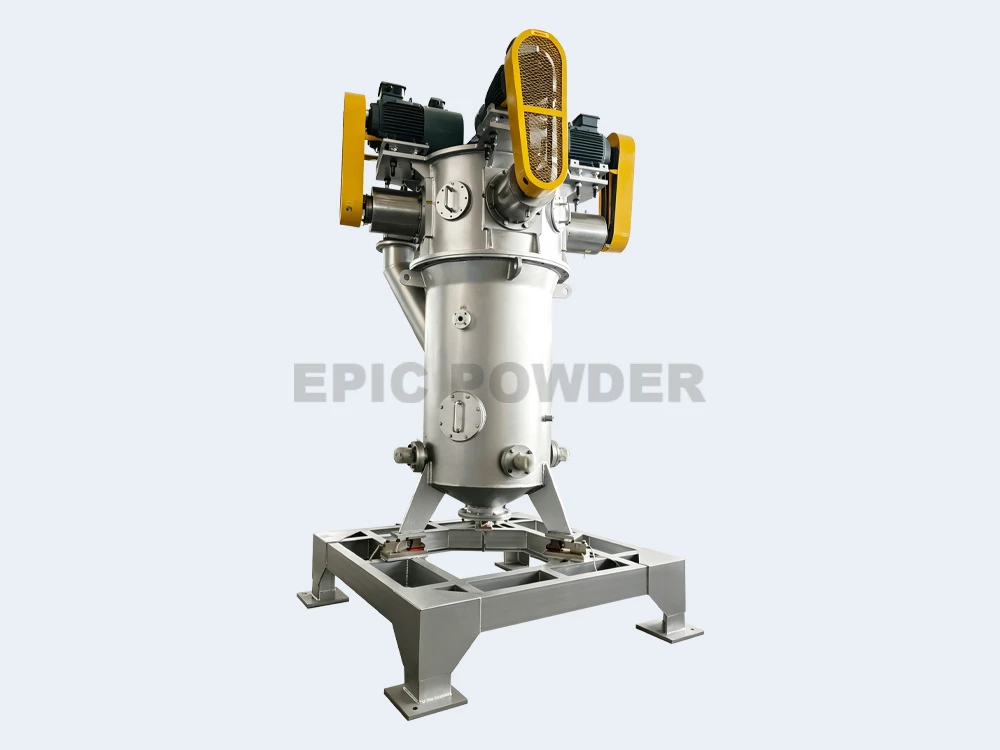
What Is a Jet Mill?
A jet mill is a device that uses high‑pressure, supersonic gas streams to accelerate particles and cause them to collide with each other, resulting in particle size reduction. Unlike ball mills or hammer mills, jet mills operate without any grinding media—the particles grind themselves through inter‑particle impact, friction, and shear. The mill features an integrated high‑speed classifier wheel that simultaneously performs grinding and classification in a single step, producing powders with a narrow particle size distribution and precise control over the final fineness.
Jet mills can operate with various process gases—including compressed air, nitrogen, inert gases, or chilled air—making them ideal for high‑purity materials (no media contamination), heat‑sensitive products (low temperature rise during milling), oxidation‑sensitive materials (inert gas operation), and explosive or flammable substances (closed‑loop inert systems). The global jet mill market was valued at USD 163.3 million in 2025 and is projected to reach USD 217.5 million by 2034, growing at a compound annual growth rate (CAGR) of 3.14% from 2026 to 2034. Asia Pacific currently dominates the market, holding a 40.8% share in 2025. The fluidized bed jet mill segment alone is projected to account for 57.3% of market revenue in 2025, with the broader fluidized bed opposed‑air jet mill market expected to grow from USD 846.3 million in 2025 to USD 1.5 billion by 2035 at a CAGR of 5.9%.
How Does a Jet Mill Work?
The working principle of a jet mill can be broken down into four sequential stages. First, dry, filtered compressed gas is accelerated through Laval nozzles to supersonic speeds of Mach 1.5–2.0 or higher, and this high‑velocity gas stream is injected into the sealed grinding chamber. Second, material is fed into the grinding zone via a screw feeder; the high‑speed gas stream fluidizes the particles, suspending them in a turbulent flow. Particles collide with each other at high velocity—impacting, shearing, and fracturing into finer sizes. This is purely particle‑on‑particle impact, with no media contact, eliminating metal contamination from the grinding process itself.
Third, the gas stream carries the ground particles upward to the classifier zone, where a high‑speed rotating classifier wheel generates strong centrifugal force. Coarse particles are thrown back to the grinding chamber for further reduction, while fine particles that meet the size specification pass through and are carried to the collection system. Finally, the qualified fine powder enters a cyclone separator and a pulse jet bag filter for collection, with clean exhaust gas discharged and the entire system operating under negative pressure with no dust leakage.
In simple terms: high‑pressure gas accelerates particles → particles collide and break → the classifier screens automatically → coarse particles recycle for re‑grinding. Pure inter‑particle impact with zero media contact means zero metallic contamination from the grinding process from the outset.
Jet Mill Classification
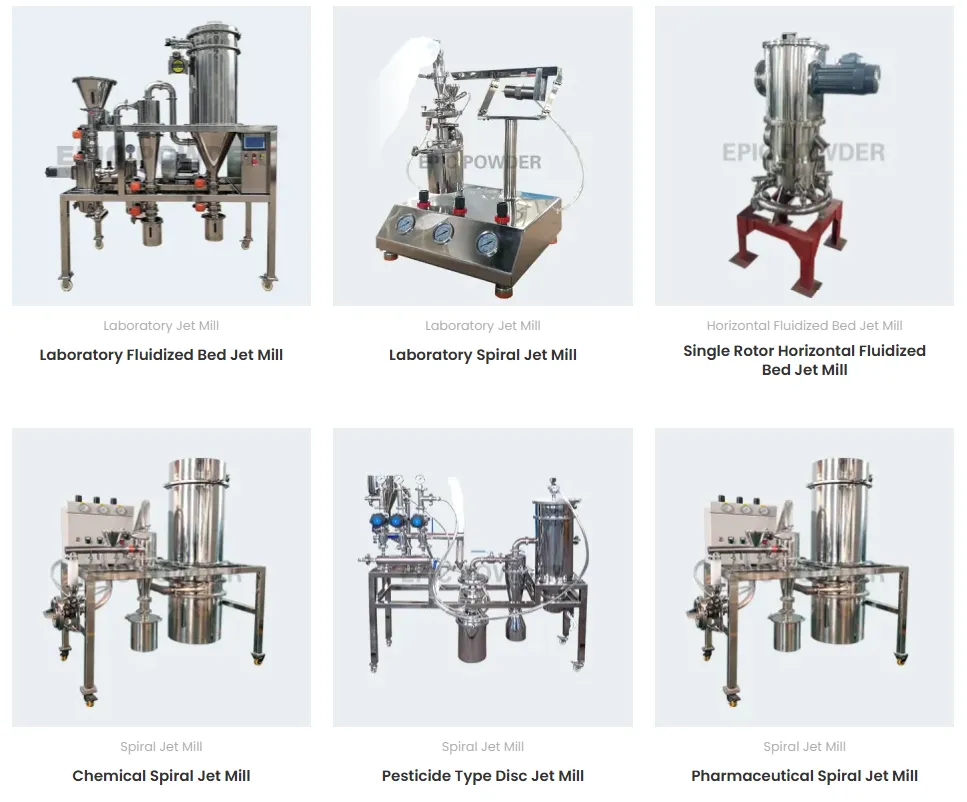
Jet mills come in various configurations, each suited to different materials and applications. The following table summarizes the main structural types, their typical applications, and key advantages and limitations.
| Type | Best‑for Materials | Key Advantages | Limitations |
|---|---|---|---|
| Spiral (Flat/Disc) Jet Mill | Medium‑hard minerals, chemical fillers | Uniform particle size distribution; classic, proven design | Higher energy consumption per unit output |
| Fluidized Bed Jet Mill | Lithium batteries, pharmaceuticals, food powders, fine chemicals | Lower energy use, reduced wear, high throughput, low maintenance, excellent PSD control | Higher initial investment (offset by operating savings) |
| Loop (Circulating Tube) Jet Mill | Brittle, low‑hardness materials (e.g., calcium carbonate, talc) | Good uniformity for soft materials; can handle some hard types with special designs | Large footprint; limited to certain hardness ranges |
| Opposed (Opposing) Jet Mill | Small‑batch, high‑purity products (pharma, food additives) | No media or wall contamination; very high efficiency and consistency | Complex structure, bulky, high energy consumption |
| Target (Impact) Jet Mill | Heat‑sensitive materials, rare‑earth magnets (up to Mohs 9) | Suitable for hard and heat‑sensitive feeds | Target plate erosion; product contamination risk; high energy use |
Beyond structural differences, jet mills are also classified by process gas type. Air‑class mills use compressed air for non‑oxidizing materials like calcium carbonate and alumina—this is the lowest‑cost option. Inert‑gas‑protected mills use nitrogen or argon for oxidation‑sensitive and explosive materials such as lithium‑ion anode powders, metal powders, and phosphides, operating in closed‑loop oxygen‑free systems. Cryogenic mills use chilled gas to process heat‑sensitive materials like pharmaceutical APIs, food additives, and resin powders, where low temperature prevents degradation.
By production scale, laboratory‑scale models (50–300 L batch) are ideal for R&D and sample development with minimal material loss, while industrial production models range from tens of kilograms to several tons per hour for large‑scale manufacturing. By liner material, stainless steel is general‑purpose; ceramic is required for high‑purity, iron‑free applications; and polyurethane serves abrasive and contamination‑sensitive processes. A critical rule: for pharmaceuticals, battery cathodes, and cosmetics, full ceramic liners are mandatory to eliminate metal contamination.
Core Components of a Jet Mill System
A complete jet milling system consists of several critical components, each directly impacting powder purity, throughput, and equipment lifespan. The table below lists the main parts and their functions.
| Component | Function |
|---|---|
| Grinding Chamber | Core space for particle collisions; replaceable wear‑resistant liners prevent contamination |
| Laval Supersonic Nozzles | Accelerate gas to supersonic speed; wear reduces fineness and capacity |
| High‑Speed Classifier Wheel | Controls final particle size (D50/D97); speed adjustment enables precise PSD tuning |
| Screw Feeding System | Delivers material at a consistent, controllable rate; feed rate directly affects grinding results |
| Air Treatment Unit | Compressor, dryer, and precision filters ensure dry, oil‑free, water‑free gas |
| Collection System | Cyclone separator + pulse bag filter collects finished powder and captures ultrafine dust |
| PLC Control System | Integrated control for pressure, feed rate, classifier speed, and temperature |
| Closed‑Loop Piping | Negative‑pressure sealing prevents dust leaks; inert models enable gas recycling |
Jet Mill Selection: 6 Critical Factors
Choosing the wrong jet mill can result in fineness failures, low throughput, material oxidation, or rapid chamber wear. To make an informed decision, evaluate your process against these six criteria:
Material physical & chemical properties – Heat‑sensitive or low‑melting feeds require cryogenic mills; lithium/metal powders demand inert gas protection; high‑purity products need ceramic liners; high‑hardness abrasives suit loop or target types.
Target particle size – General micro‑powders can use spiral mills; ultra‑fine, narrow PSD, high‑throughput jobs call for fluidized bed mills; nano‑scale powders need multi‑stage classification. Jet mills typically achieve D50 from 1 µm to 20 µm (or up to 50+ µm) with sharp PSD.
Production capacity – R&D/pilot scales use lab models; continuous industrial production requires high‑capacity fluidized bed units, and multiple units can be paralleled for expanded output.
Purity requirements – For iron‑ and heavy‑metal‑sensitive industries (pharma, battery cathodes, cosmetics), ceramic or polyurethane iron‑free liners are non‑negotiable.
Energy consumption & maintenance costs – For long‑term, high‑volume production, fluidized bed jet mills consume up to 30% less energy than spiral types under equivalent capacity, with longer nozzle and liner replacement intervals.
Whole‑line integration – Consider upstream drying (for wet feed) and downstream screening, blending, and mixing equipment; for inert gas systems, install online oxygen monitors.
Common Jet Mill Problems and Their Solutions
Even well‑maintained jet mills can encounter operational issues. The following table outlines typical symptoms, root causes, and practical remedies.
| Symptom | Common Causes | Solutions |
|---|---|---|
| Coarse or inconsistent particle size; low fine yield | Classifier speed too low; insufficient grinding pressure; feed rate too high; worn nozzles | Increase classifier speed; check compressor pressure; reduce feed rate; replace nozzles |
| Frequent nozzle/chamber blockages & build‑up | High material moisture; sticky product; humid environment; residual material after shutdown | Pre‑dry feed; reduce batch size; improve environment; clean chamber and nozzles thoroughly after each run |
| Dust emission from filter outlet | Broken bag filters; failed seals; pulse‑cleaning solenoid malfunction | Replace damaged bags; reinforce housing seals; repair pulse controller/solenoid |
| Throughput drop at same pressure | Nozzle wear (enlarged diameter); chamber liner wear; clogged air filters | Replace all nozzles; repair/replace liners; replace precision air filters regularly |
| Oxygen content exceeds limit (inert systems) | Pipeline leaks; insufficient inert gas supply; aged dust‑collector door seals | Inspect and seal all gas lines; increase inert gas feed; replace aged gaskets |
| Abnormal noise / classifier vibration | Foreign objects in chamber; worn classifier bearings; unstable feed rate | Stop and remove debris; replace high‑speed bearings; stabilize screw feeder speed |
Jet Mill Maintenance Best Practices
Jet mills are precision high‑speed equipment with multiple wear parts (chamber, classifier wheel, nozzles). Proper maintenance significantly reduces failure rates and extends component life. The following table summarizes recommended maintenance actions and frequencies.
| Item | Action | Frequency |
|---|---|---|
| Daily startup checks | Verify air pressure, dryness, valve seals; run idle to check classifier noise; test pulse cleaning | Every startup |
| Air system | Drain dryer condensate; replace primary and secondary precision air filters | Condensate: weekly; Filters: monthly |
| Wear parts inspection | Check nozzles for wear; inspect ceramic liners and classifier blades | Nozzles: 3–12 months; Liners/blades: every 6 months |
| Post‑shutdown cleaning | Purge and brush‑clean chamber, classifier zone, and piping; for sticky materials, use warm water or cleaning agents | After each run / before material change |
| Electrical & drive | Lubricate high‑speed bearings with high‑temp grease; keep control cabinets dust‑free | Bearings: scheduled per hours; cabinets: daily |
| Inert gas system | Calibrate oxygen analyzers; inspect nitrogen pipeline seals | Analyzers: weekly; seals: monthly |
| Long‑term storage | Empty chamber, purge/dry pipelines, apply protective coating, close gas supply, disconnect power | Before extended downtime |
Beyond these scheduled tasks, always remember that moisture and oil in the process gas are the enemy—they contaminate product and accelerate nozzle wear. For inert gas systems, air ingress is a safety risk, so seal integrity must be verified regularly.
Summary
Jet mills are the core equipment for high‑end ultrafine powder processing. Unlike ball mills or other media‑based grinding equipment, the media‑free grinding principle gives jet mills an irreplaceable position in high‑value industries such as lithium batteries (cathode materials like LFP and NCM), pharmaceuticals (API micronization for improved bioavailability), high‑purity ceramics, fine chemicals, food and nutraceuticals, and cosmetics. The growing requirement for uniform and ultra‑fine particle sizes—particularly within pharmaceutical and specialty chemical applications—continues to drive market growth. Manufacturers are investing significantly in R&D to upgrade jet milling technology with design innovations, material handling, and process control improvements.
Proper type selection, precise sizing, and disciplined maintenance directly determine final powder quality and consistency, production line energy efficiency, and overall operating costs. With the right jet mill and proper operation, you can achieve contamination‑free, ultra‑fine powders with tight particle size distributions—delivering the performance your high‑value products demand.
About the Author: This guide is brought to you by Epic Powder Machinery, a leading provider of jet milling solutions for the pharmaceutical, battery materials, chemical, and food industries. For more information on our jet mill equipment and powder processing solutions, visit www.jet-mills.com or contact our team of experts.
Epic Powder
At Epic Powder, we offer a wide range of equipment models and tailor solutions to meet your specific needs. Our team has more than 20 years experience in various powders processing. Epic Powder is specialized in fine powder processing technology for mineral industry, chemical industry, food industry, pharama industry, etc.
Contact us today for a free consultation and customized solutions!

“Thanks for reading. I hope my article helps. Please leave a comment down below. You may also contact EPIC Powder online customer representative Zelda for any further inquiries.”
— Jason Wang, Engineer