
What is Lithium Cobalt Oxide (LCO)? A Quick Overview
Lithium Cobalt Oxide, with the chemical formula LiCoO₂ (commonly abbreviated as LCO), is the earliest and most classic cathode material for lithium batteries. If you use a smartphone, Android device, laptop, or Bluetooth earphones, chances are the battery inside runs on LCO. This article introduces the complete guide to Lithium Cobalt Oxide (LiCoO₂) — from key properties and advantages to the detailed manufacturing process. Learn how advanced jet mills from Epic Powder achieve precise particle size reduction for high-performance Lithium Cobalt Oxide cathode materials.
In a typical lithium battery using LCO, manufacturers make the cathode from Lithium Cobalt Oxide, the anode from graphite, and the electrolyte from carbonate solvents and LiPF₆. They also include conductive additives like carbon nanotubes or carbon black to enhance performance.
In a typical lithium battery using LCO, the cathode is made of Lithium Cobalt Oxide, the anode is graphite, and the electrolyte consists of carbonate solvents and LiPF₆. Conductive additives like carbon nanotubes or carbon black are also included to enhance performance. The role of LCO is simple but crucial: it stores and releases lithium ions during charging and discharging. When you charge the battery, lithium ions move from the LCO cathode to the graphite anode. When you discharge it, those ions travel back from the anode to the cathode. In short, LCO acts as the primary warehouse for lithium ions.
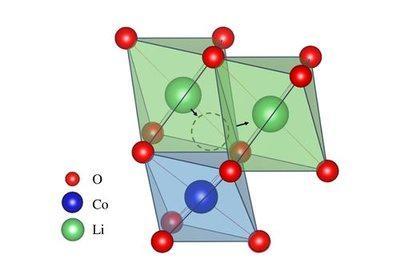
Key Advantages of LCO
So why is LCO so widely used, especially in smartphones and laptops? The reasons are straightforward. First, it offers a high operating voltage of around 3.9V, which translates into high energy density per unit of volume. That means manufacturers can make batteries thinner without sacrificing capacity. Second, LCO provides excellent cycling stability and a very flat discharge voltage platform, ensuring that your phone doesn’t lose power or experience voltage drops during use. Third, LCO has a high tap density, allowing the electrode to be compacted tightly so more energy fits into the same space. Finally, while it performs well in small current scenarios like mobile devices, it is not typically used in electric vehicles due to safety and cost considerations. For consumer electronics, however, LCO remains the undisputed king of cathode materials.
Disadvantages of LCO
However, LCO is not without its drawbacks. The most significant issue is its cost: cobalt is an expensive and strategically important metal with high price volatility. Safety is another concern. LCO can suffer from structural collapse under high temperatures or overcharging, leading to thermal runaway and, in extreme cases, fire. That is why pure LCO is rarely used in electric vehicle batteries. Additionally, LCO is not well suited for large-format batteries. It truly shines only in small consumer electronics like phones, laptops, and wearables, while EVs typically rely on NCM (nickel-cobalt-manganese) or LFP (lithium iron phosphate) chemistries.
How LCO Compares to Other Cathode Materials
To put things in perspective, LCO delivers the highest energy density among mainstream cathode materials, but it is also the most expensive and has only moderate safety characteristics. NCM offers a balanced tradeoff between energy, cost, and safety, making it the goto choice for electric vehicles. LFP, on the other hand, is the safest and most affordable, with a very long cycle life, but its energy density is lower. So the simple rule is: phones and tablets use LCO, while EVs use NCM or LFP. LCO is tailor-made for thin, compact, high-capacity batteries in consumer electronics.
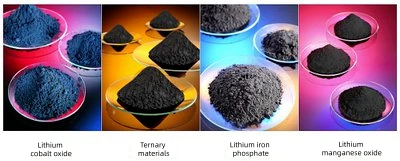
LCO vs. Other Cathode Materials
| Material | Main Application | Characteristics |
| LCO | Smartphones, tablets, laptops | Highest energy density, expensive, moderate safety |
| NCM (NMC) | EV batteries | Balanced performance, safer and cheaper than LCO |
| LFP | EVs, energy storage | Very safe, low cost, long cycle life, lower energy density |
Simple rule:
- Mobile devices → LCO
- Electric vehicles → NCM or LFP
LCO is tailor-made for thin, compact, high-capacity batteries in consumer electronics.
Lithium Cobalt Oxide Manufacturing Process Flow
The production of LCO involves a series of carefully controlled steps, from raw material handling to final packaging. Below is a detailed walkthrough of the typical process, with special attention to the jet milling stages — where Epic Powder’s advanced technology delivers superior particle size reduction for high-quality cathode materials.
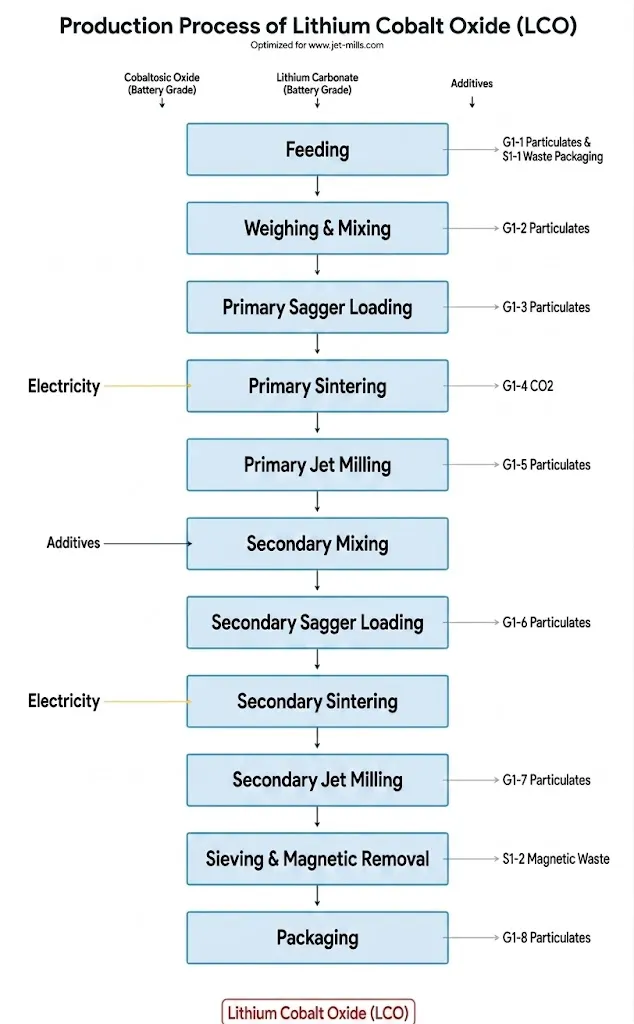
1. Raw Material Receiving
Raw materials include Co₃O₄ (cobalt tetroxide), Li₂CO₃ (lithium carbonate), and additives. Co₃O₄ and Li₂CO₃ are supplied in ton bags; additives in 20 kg bags. Materials are stored in a raw material area.
2. Feeding & Batching
Materials are lifted into storage hoppers. Ton bags are opened above the hopper, and materials are manually fed. A dust collection hood captures minimal fugitive dust, which is recycled back into the hopper.
3. Weighing & Mixing
After entering storage hoppers, materials are automatically weighed in a closed system. Dust is collected by bag filters and returned to the weighing hopper. The Li₂CO₃ : Co₃O₄ ratio is approximately 0.4~0.49 : 1. Mixing is a physical process (no chemical reaction) until no white spots remain. Mixed material is sent to the first loading station.
4. First Loading into Saggars
The mixed powder is loaded into saggars (ceramic crucibles). A small amount of dust is captured by bag filters and returned to the process.
5. First Sintering (Calcination)
Saggars enter an electrically heated roller kiln. Temperature: 1000–1100°C; Time: 20–28 hours. Oxygen (from air) is introduced via a blower. The main reaction: 6Li₂CO₃ + 4Co₃O₄ + O₂ → 12LiCoO₂ + 6CO₂
Only CO₂ is emitted — no NOx forms below 1200°C
6. First Crushing – The Role of Jet Mills
After sintering, the LCO agglomerates are conveyed to the crushing section. This step uses two-stage milling:
Fine crushing – An air jet mill further reduces lithium cobalt oxide particle size.
Rough crushing – A pin mill (rotary wheel mill) breaks large chunks into coarse powder.
How Epic Powder’s jet mills work: Filtered and dried compressed air is injected through specially designed nozzles at high velocity into the milling chamber. At the intersection of these high-speed air jets, particles collide, rub, and shear against each other — achieving uniform, fine grinding without any moving parts contacting the material. A high-speed classifying wheel separates fine particles from coarse ones. Particles that meet the required size (typically D50 between 4 and 20 μm) are drawn by suction into a cyclone and dust collector. Oversized particles fall back into the grinding zone for further size reduction.
Why does this matter for LCO? Jet milling delivers precise and narrow particle size distribution, which is critical for consistent battery performance. Because the process is particle-on-particle, there is no contamination from grinding media — a vital requirement for high-purity cathode materials. The integrated classification ensures high yield, and the closed system operates dust-free, with all collected material being returned to the secondary batching step. Clean exhaust gas is discharged via a 26-meter stack.
7. Secondary Batching (Coating)
Milled LCO is transferred via closed pipes to a coating machine. Coating materials (Al(OH)₃, TiO₂, Mg(OH)₂) are added and mixed for 20–60 minutes. The system is fully enclosed — no dust emission.
8. Second Loading into Saggars
Similar to first loading. Dust is collected by bag filters and recycled.
9. Second Sintering
Temperature: 900–1000°C; Time: 20–28 hours. This stabilizes the coating layer, modifies particle morphology, and improves uniformity and crystal integrity. No chemical reaction — only physical/structural changes. No NOx generated.
10. Second milling (Again Using Jet Mills)
After second sintering, the coated LCO is once again processed through an air jet mill (same operating principle as step 6). This achieves final particle size refinement (D50 = 4–20 μm) and ensures consistent, high-quality cathode powder. The cyclone + bag filter can collect dust, and discharge clean air.
11. Blending, Sieving & Magnetic Separation
We perform blending according to product requirements by feeding the processed material into a blending machine and mixing it to ensure uniformity. We carry out the blending operation in a closed environment, so no dust escapes. After blending, we crush and sieve the material through a 350 to 400 mesh screen. We return the oversize material for further crushing and send the undersize material to the next step.
We then apply magnetic separation to remove magnetic impurities from the material. This step generates no dust because we only remove iron from the raw material, which already has a very low iron content. We perform this step to ensure product quality and keep the iron content within control limits, so dust generation is virtually nonexistent. Before packaging, we treat the product to remove magnetic impurities, achieving an impurity removal rate of 0.2%.
12. Packaging
A fully automatic vacuum packaging machine uses ton bags. The bag mouth is sealed with a rubber ring during filling. After settling, the bag is sealed and stored. Also available: 25 kg aluminum foil vacuum bags packed in cartons. Final products are sampled for battery testing and physicochemical analysis. Dust from packaging is collected by bag filters and returned to the packaging front end.
Why Epic Powder’s Jet Mills Are Ideal for LCO and Battery Materials
At Epic Powder, our jet mills can pulverize high-value materials like lithium cobalt oxide. They achieve ultra-fine grinding with a narrow particle size distribution — D50 as low as 1 to 10 microns depending on your requirements. Because there are no moving parts in the grinding zone, contamination is virtually eliminated; the material is milled by particle-on-particle impact. The integrated classifier automatically returns oversized particles, maximizing yield and efficiency. The closed system design ensures dust-free operation, meeting strict environmental and safety standards. And with no wear parts in direct contact with abrasive LCO, maintenance requirements are low.
Whether you are producing LCO for consumer electronics or developing next-generation cathode materials, Epic Powder’s jet milling solutions deliver the consistency, purity, and throughput you need. Contact us today to learn how our jet mills can optimize your lithium cobalt oxide powder processing.
Epic Powder
At Epic Powder, we offer a wide range of equipment models and tailor solutions to meet your specific needs. Our team has more than 20 years experience in various powders processing. Epic Powder has fine powder processing technology for mineral industry, chemical industry, food industry, pharama industry, etc.
Contact us today for a free consultation and customized solutions!

“Thanks for reading. I hope my article helps. Please leave a comment down below. You may also contact EPIC Powder online customer representative Zelda for any further inquiries.”
— Jason Wang, Engineer