
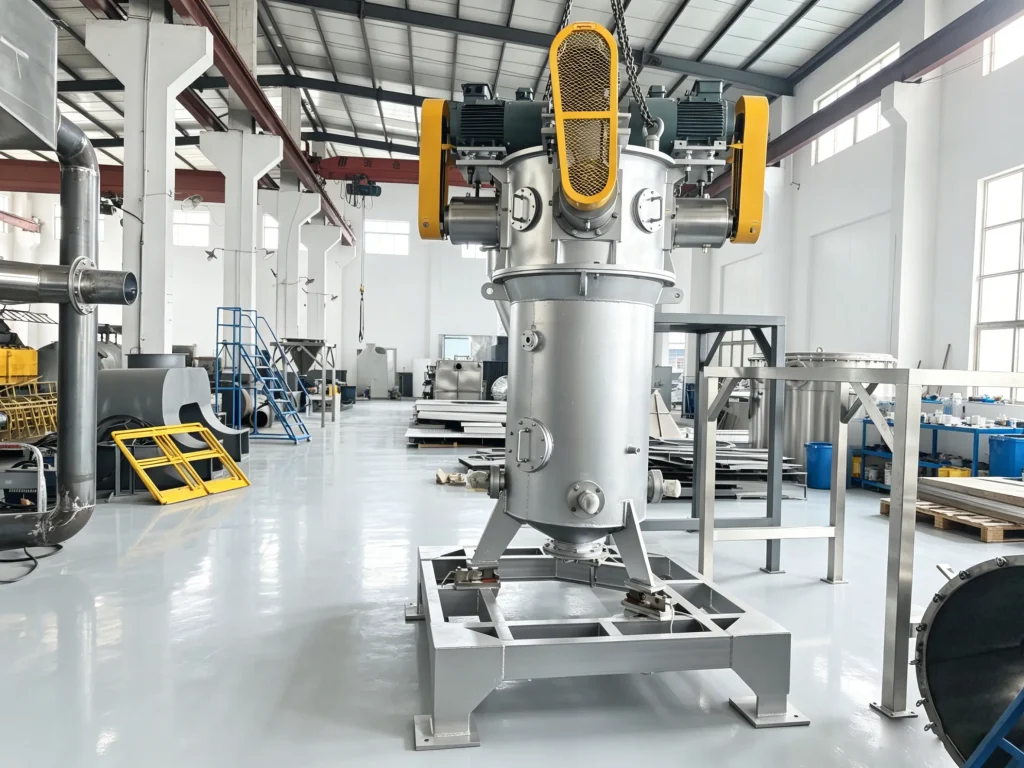
A pabrik jet utilizes high-velocity airflow or superheated steam to accelerate particles into collision, abrasion, and shear interactions, achieving fine grinding down to micron or even nanometer scales. This jet milling machine technology has become indispensable across advanced manufacturing sectors, from aerospace materials to battery powders.
Untuk procurement professionals, the key considerations are total cost of ownership, equipment reliability, and production scalability. For engineering teams, the focus lies on particle size distribution (PSD) control, product purity, and process stability. This article examines air-jet milling applications through both lenses, providing a balanced reference for equipment selection and process optimization.
Industry Applications: Technical Benefits & Procurement Considerations
Aerospace & Defense
Engineering Perspective: Ultrafine powders produced by a jet milling machine are critical for stealth coatings and advanced propellants. Rocket propellants incorporating air-jet-milled oxidizers and catalysts demonstrate combustion rates exceeding twice those of conventionally ground formulations. It’s a direct result of precisely controlled particle morphology and specific surface area.
Procurement Perspective: The contact-free grinding mechanism eliminates metallic contamination, which is non-negotiable for defense-grade materials. When specifying a jet milling machine, consider wear-resistant liners (e.g., alumina or silicon carbide) to handle abrasive feedstocks and extend service life.
Chemicals & Pigments
Engineering Perspective: Titanium dioxide (TiO₂) pigment demands tight PSD control and exceptional purity. Jet milling machines, particularly those equipped with high-efficiency classifiers, deliver the narrow particle distribution required for optimal opacity, stability, and optical performance. The absence of grinding media also preserves the pigment’s surface chemistry.
Procurement Perspective: For high-volume TiO₂ production, fluidized-bed jet milling machines offer superior energy efficiency compared to traditional spiral designs. Evaluate the classifier system’s maintenance intervals and spare parts availability—these directly impact uptime and operating costs.
Rubber & Energy
Engineering Perspective: Nano-zinc oxide processed via a jet milling machine exhibits excellent deagglomeration and dispersibility in organic solvents, significantly enhancing natural rubber vulcanization performance. In biomass applications, air-jet-milled straw increases surface area for enzymatic hydrolysis, improving biogas fermentation yields.
Procurement Perspective: For biomass preprocessing, moisture content (>5%) can severely impact mill efficiency—consider integrating a pre-drying stage. For rubber-grade zinc oxide, confirm that the jet milling machine‘s containment system prevents cross-contamination between batches.
Electronics & Advanced Materials
Engineering Perspective: Ultrafine iron oxide, silica, and alumina powders are foundational to high-performance magnetic materials, resistors, and LED sapphire substrates. A jet milling machine can process molybdenum powder to achieve finer particle size, narrower distribution, uniform morphology, and improved bulk/tapped density—critical parameters for electron tubes and IC substrates.
Procurement Perspective: High-purity electronics applications demand rigorous contamination control. Specify jet milling machines with ceramic-lined chambers and verify that the classifier system can achieve the required D50 and span values (e.g., D90/D10 ratio) consistently. Request validation data from the manufacturer’s lab-scale testing.
Pharmaceuticals & Traditional Medicine
Engineering Perspective: A jet milling machine increases cell-wall rupture rates in herbal materials, enhancing active ingredient release and bioavailability. Studies on ginseng, notoginseng, and other saponin-containing herbs show significantly higher ginsenoside extraction yields post-milling. The enclosed grinding environment prevents heavy metal contamination and ensures GMP compliance.
Procurement Perspective: For pharmaceutical applications, confirm that the jet milling machine design supports CIP/SIP (clean-in-place/steam-in-place) protocols and meets relevant regulatory standards (e.g., cGMP). Sealed operation also minimizes operator exposure to potent compounds—a critical safety and compliance factor.
Cosmetics & Personal Care
Engineering Perspective: Air-jet-milled colorants and fillers improve pressed-powder compaction density, adhesion, and smoothness in foundations and eyeshadows. In skincare, micronized andrographolide shows enhanced water solubility and retained antibacterial activity, while vitamin C and pearl powders exhibit better dermal absorption.
Procurement Perspective: Batch-to-batch consistency is paramount in cosmetics. Evaluate the jet milling machine‘s automated control system for real-time PSD monitoring and recipe storage. Also consider the ease of cleaning between color changes—downtime for color transitions can be a significant cost driver.
Food & Nutraceuticals
Engineering Perspective: Air-jet-milled grape seeds show higher cell-wall rupture, faster active-compound dissolution, and increased bioactivity. Rice retains its nutritional components while achieving modified physicochemical properties. The contamination-free process also preserves product integrity without irradiation effects.
Procurement Perspective: Food-grade applications require stainless steel construction and compliance with FDA/EFSA material contact standards. Verify that the jet milling machine‘s air filtration system meets food safety requirements (e.g., HEPA filtration) to prevent microbial contamination.
New Energy Battery Materials
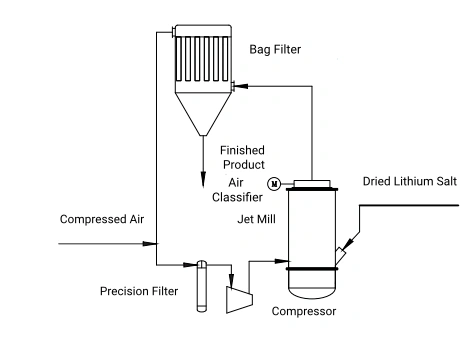
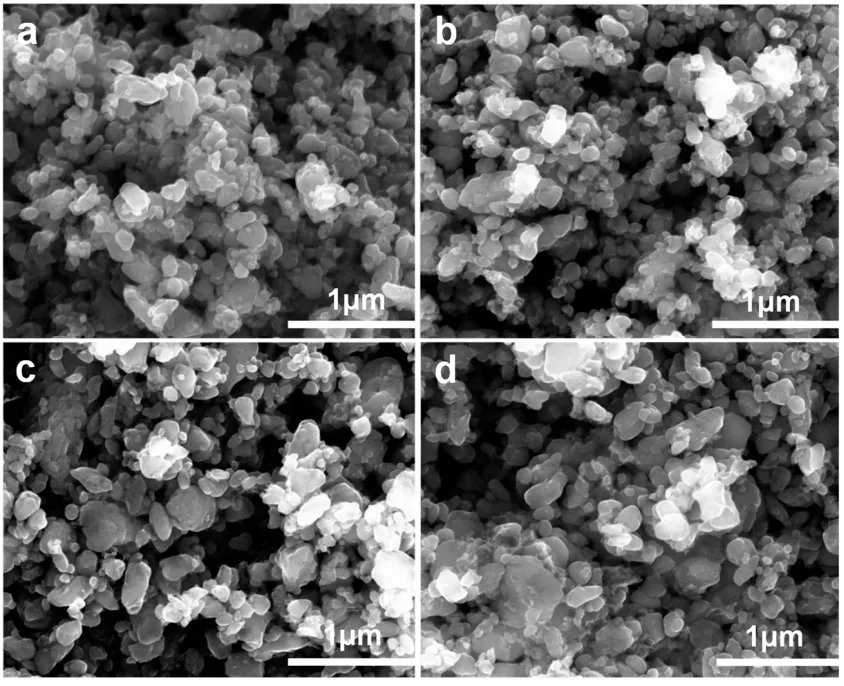
Engineering Perspective: Battery-grade lithium salts (carbonate/hydroxide) are crystallized and dried to 50–80 μm particles, then processed by a jet milling machine to final specifications. Fluidized-bed designs with integrated classifiers deliver precise PSD control. For lithium iron manganese phosphate (LFMP) cathodes, air-jet milling produces uniform nanoscale particles, increasing specific surface area, improving electrolyte wetting, shortening Li⁺ diffusion paths, and enhancing both tap density and volumetric energy density.
Procurement Perspective: Battery material production runs are typically high-volume and continuous. Prioritize jet milling machines with robust wear parts (e.g., tungsten carbide-coated nozzles), low maintenance requirements, and high on-stream reliability. Energy consumption per ton of finished product is a critical metric—request comparative data from multiple suppliers.
Technology Overview & Development
The first single-nozzle jet milling machine was proposed by Gómez in the 1890s, with rapid industrialization throughout the 20th century. As industries demand ever-finer particles, traditional mechanical grinding methods increasingly fall short. A modern jet milling machine produces functional ultrafine powders that serve either as end-products or as intermediates for composite materials.
In China, jet milling machines first gained traction in the dye industry and later expanded into aerospace, mineral processing, and refractories. Among ultrafine grinding technologies, the jet milling machine stands out for its product purity—since it uses compressed air or steam as the grinding medium, no foreign media are introduced, eliminating contamination risks.
Today, the fluidized-bed jet milling machine is among the most widely adopted designs. Its key advantages include:
- Higher energy efficiency: Fluidization during grinding improves collision probability and reduces energy waste.
- Reduced wear: Air and material enter the grinding chamber via separate paths, minimizing pipeline erosion.
- Klasifikasi terintegrasi: Grinding and classifying occur in a single unit, with automated controls enabling real-time PSD adjustment and consistent product quality.
Bubuk Epik
Bubuk Epik is a specialized manufacturer of jet milling machines and air classification systems, established in 2012 and headquartered in Qingdao, China. We focus on R&D for ultra-fine and ultra-pure pulverization, powder shape control, selective grinding, surface modification, and comprehensive powder industry solutions. Our independently developed jet milling machines and air classifiers are widely deployed in powder processing. Our product portfolio includes horizontal and vertical fluidized-bed jet milling machines, spiral jet milling machines, laboratory-scale jet milling machines, and specialized systems for lithium battery materials and non-metallic minerals.

Terima kasih sudah membaca. Semoga artikel saya membantu. Silakan tinggalkan komentar di bawah. Anda juga bisa hubungi EPIC Perwakilan pelanggan online Powder Zelda untuk pertanyaan lebih lanjut.”
— Jason Wang, Insinyur